On my k3s cluster one wildcard certificate covers jithendar.com and every subdomain, and nobody renews it by hand. cert-manager requests it from Let's Encrypt, proves domain control through Cloudflare DNS, stores it in a Kubernetes Secret and replaces it before it expires. This article shows the exact setup and then follows one renewal from start to finish.
Part 1 (opens in a new tab) explains Let's Encrypt and the ACME protocol on their own. Here I assume you know what a challenge is.
Every implementation detail below is what my infrastructure repository declares in Git and Terraform applies. Recommendations are marked as such.
The cluster and the goal
mk4 is a k3s cluster on Hetzner Cloud, created with hetzner-k3s. It has one control-plane node that runs no workloads and two ARM workers with 4 vCPU and 8 GB each. Until 10 November 2026 mk4 was a Minikube profile on a single server, which is why many folder names in the repository still say minikube.
The cluster hosts this website and several tools, on more than one hostname:
jithendar.comandwww.jithendar.comover HTTPSregistry.jithendar.com(Harbor) andjfrog.jithendar.comover HTTPSpostgres.jithendar.comandredis.jithendar.comas TLS-wrapped TCP on port 443
I wanted three things: one certificate for all of them, no renewal work, and no dependency on an HTTP route staying open.
Architecture
One wildcard certificate, issued over DNS-01, served by the Istio ingress gateway.
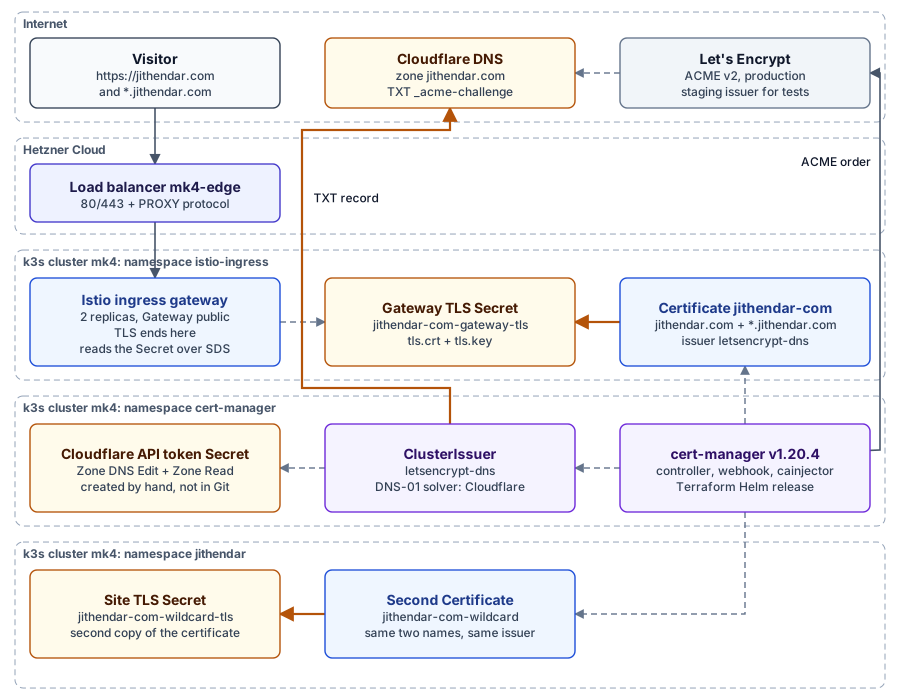
| Piece | What it is on mk4 | Role |
|---|---|---|
| Edge | Hetzner load balancer mk4-edge, ports 80 and 443, PROXY protocol | Sends traffic to the gateway pods |
| Gateway | Istio ingress gateway, 2 replicas, Gateway public in namespace istio-ingress | Terminates TLS for every hostname |
| cert-manager | Chart v1.20.4 in namespace cert-manager | Requests, stores and renews certificates |
| Issuers | ClusterIssuers letsencrypt-dns and letsencrypt-dns-staging | Hold the ACME account and the DNS-01 solver |
| DNS | Cloudflare zone jithendar.com | Where the challenge TXT record is written |
| Certificates | istio-ingress/jithendar-com and jithendar/jithendar-com-wildcard | Both list jithendar.com and *.jithendar.com |
Why DNS-01 and not HTTP-01
The cluster first used HTTP-01 through Traefik. I moved to DNS-01 for two reasons.
Wildcards. Let's Encrypt issues *.jithendar.com only over DNS-01. With a wildcard, a new subdomain needs no new certificate.
Renewal does not touch the web path. With HTTP-01, every renewal needs port 80, the ingress controller and a temporary route to work. With DNS-01, cert-manager talks to the Cloudflare API and Let's Encrypt asks DNS. The gateway is not involved, so a routing change cannot break a renewal.
The price is a Cloudflare API token inside the cluster. I limit it to the one zone.
Step 1: install cert-manager
Terraform installs the official chart as a Helm release (shortened):
resource "helm_release" "cert_manager" {
  name             = "cert-manager"
  namespace        = "cert-manager"
  create_namespace = true
  repository       = "oci://quay.io/jetstack/charts"
  chart            = "cert-manager"
  version          = "v1.20.4"
  values           = [file("${local.minikube}/cert-manager/values.yaml")]
  wait             = true
}
The values file is short, and two parts of it matter:
crds:
  enabled: true
webhook:
  podLabels:
    sidecar.istio.io/inject: "false"
dns01RecursiveNameservers: "https://1.1.1.1/dns-query,https://8.8.8.8/dns-query"
dns01RecursiveNameserversOnly: true- No sidecar on the webhook. The API server calls the webhook directly on every cert-manager resource change. A mesh proxy that is not ready yet would fail those calls.
- DNS over HTTPS for the self-check. Without it the wildcard certificate never issued. The story is under What went wrong.
Without Terraform, the same install is one command:
helm install cert-manager oci://quay.io/jetstack/charts/cert-manager \
  --version v1.20.4 --namespace cert-manager --create-namespace \
  --set crds.enabled=true
Step 2: the Cloudflare token
The issuer needs a Cloudflare API token with Zone, DNS, Edit and Zone, Zone, Read on the jithendar.com zone only. It lives in a Secret that I create by hand, so the token never reaches Git:
kubectl -n cert-manager create secret generic cloudflare-api-token \
  --from-literal=api-token=REPLACE_ME
The Secret must exist before issuance. Without it the ClusterIssuers still register their ACME accounts, but the Certificate stays False until the Secret appears.
Step 3: staging and production ClusterIssuers
A ClusterIssuer holds the ACME account and says how to solve challenges. A small local Helm chart renders two of them, identical except for name and server URL. This is the production one:
apiVersion: cert-manager.io/v1
kind: ClusterIssuer
metadata:
  name: letsencrypt-dns
spec:
  acme:
    email: [email protected]
    server: https://acme-v02.api.letsencrypt.org/directory
    privateKeySecretRef:
      name: letsencrypt-dns-account-key
    solvers:
      - selector:
          dnsZones: [jithendar.com]
        dns01:
          cloudflare:
            apiTokenSecretRef:
              name: cloudflare-api-token
              key: api-token
letsencrypt-dns-staging points at https://acme-staging-v02.api.letsencrypt.org/directory and keeps its own account key. It is there for testing, because production allows only five certificates per week for the same set of names.
privateKeySecretRef is the ACME account key, not the certificate key. cert-manager generates it on first use and keeps it in that Secret.
Step 4: request the certificate
A Certificate resource is a standing order: these names, from this issuer, into this Secret.
apiVersion: cert-manager.io/v1
kind: Certificate
metadata:
  name: jithendar-com
  namespace: istio-ingress
spec:
  secretName: jithendar-com-gateway-tls
  dnsNames:
    - jithendar.com
    - "*.jithendar.com"
  issuerRef:
    group: cert-manager.io
    kind: ClusterIssuer
    name: letsencrypt-dns
It sits in istio-ingress because an Istio Gateway can only read a credentialName Secret from the namespace of the gateway pods. The Gateway then points every HTTPS and TLS server at it (shortened, the two TCP servers are left out):
servers:
  - port: {number: 443, name: https, protocol: HTTPS}
    hosts:
      - istio-ingress/jithendar.com
      - istio-ingress/www.jithendar.com
      - harbor/registry.jithendar.com
      - jfrog/jfrog.jithendar.com
    tls:
      mode: SIMPLE
      credentialName: jithendar-com-gateway-tls
      minProtocolVersion: TLSV1_2
  - port: {number: 80, name: http, protocol: HTTP}
    hosts: [] # the same four hosts
    tls:
      httpsRedirect: true
A second Certificate, jithendar-com-wildcard in namespace jithendar, requests the same two names into the Secret jithendar-com-wildcard-tls. Two Certificates with an identical name set count against the same weekly limit of five, so I do not delete and re-create them casually.
Notice what the Certificate does not set: duration, renewBefore and privateKey. Leaving them out is what makes renewal adapt by itself, as the next section shows.
How renewal works with no manual step
cert-manager is a controller: it compares what the Certificate asks for with what the Secret holds, all the time. There is no cron job and no renew command to schedule.
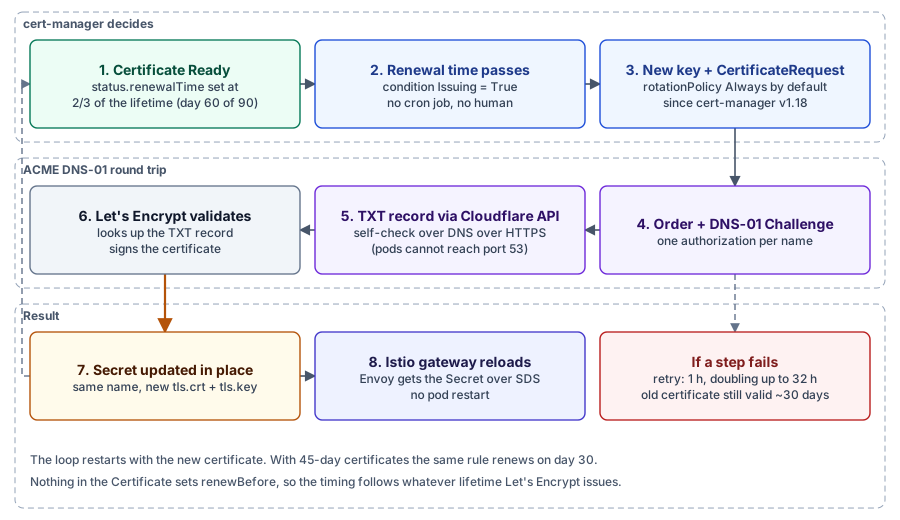
- A renewal time is recorded. After each issuance cert-manager reads the real
notBeforeandnotAfterfrom the certificate and writesstatus.renewalTime. With norenewBeforeset, that is two thirds of the way through the lifetime: day 60 of a 90-day certificate. - The time passes. The controller sets the condition
Issuing=Trueon the Certificate. - A new key and a CertificateRequest. Since cert-manager v1.18 the default
rotationPolicyisAlways, so every renewal gets a fresh private key. The key is kept in a temporary Secret until the new certificate is signed. - An Order and Challenges. The CertificateRequest becomes an ACME Order, with one DNS-01 Challenge per name that needs validating.
- The TXT record. cert-manager calls the Cloudflare API to create
_acme-challenge.jithendar.com, then checks that the record is visible before it tells Let's Encrypt to look. - Validation and signing. Let's Encrypt looks up the record, marks the authorization valid and signs the CSR. cert-manager deletes the TXT record.
- The Secret is updated in place.
tls.crtandtls.keyinjithendar-com-gateway-tlsare replaced. The Secret keeps its name, so nothing that refers to it changes. - The gateway picks it up. Istio delivers
credentialNameSecrets to Envoy over SDS and watches them, so the gateway serves the new certificate without a pod restart.
If a step fails, the old certificate keeps working: it still has about 30 days left. cert-manager retries the request with an increasing delay, from 1 hour up to 32 hours by default.
Because the renewal time comes from the certificate's actual lifetime, nothing in this setup assumes 90 days. When Let's Encrypt's default drops to 64 days in February 2027 and 45 days in February 2028, the same Certificate renews at day 43 and day 30 with no change from me.
Checking that renewal works
These commands show the state of every piece. A forced renewal is the only real proof.
# Issuers and certificates
kubectl get clusterissuer
kubectl get certificate -A

# When will it renew, and which revision is it on?
kubectl -n istio-ingress get certificate jithendar-com \
  -o jsonpath='{.status.notAfter}{"\n"}{.status.renewalTime}{"\n"}{.status.revision}{"\n"}'

# What the gateway actually serves
echo | openssl s_client -connect jithendar.com:443 -servername jithendar.com 2>/dev/null \
  | openssl x509 -noout -issuer -dates

# Force a renewal now (cmctl is cert-manager's CLI)
cmctl renew jithendar-com -n istio-ingress
kubectl -n istio-ingress get certificaterequest,order,challenge
After a forced renewal, status.revision goes up by one and openssl shows a new notBefore, with no restart of the gateway.
What went wrong
The DNS-01 self-check timed out. Before asking Let's Encrypt to validate, cert-manager queries the zone's authoritative nameservers itself. Pods on mk4 cannot reach port 53 on the internet, so that check failed with dial tcp 172.64.33.73:53: i/o timeout and the wildcard Certificate never issued. The fix is the two Helm values from Step 1: do the check through recursive resolvers over HTTPS, and use only those.
The Certificate waited for a Secret. On 8 November the Cloudflare token Secret was not on the cluster yet. The ClusterIssuers still registered their ACME accounts, so they looked healthy, but the Certificate stayed False until the Secret was created.
Old issuer names. The HTTP-01 issuers letsencrypt-prod and letsencrypt-staging went away with Traefik. The DNS-01 issuers have different names on purpose, so an old manifest that still refers to letsencrypt-prod fails loudly instead of quietly using a different solver.
When a certificate is stuck, I walk the chain in order. Each object's events say why the next one has not appeared:
kubectl -n istio-ingress describe certificate jithendar-com
kubectl -n istio-ingress describe certificaterequest
kubectl -n istio-ingress describe order
kubectl -n istio-ingress describe challenge
kubectl -n cert-manager logs deployment/cert-manager --tail=100
What I would add next
These are recommendations, not things running on mk4 today.
- Expiry alerts. My values file has
prometheus.enabled: false, so cert-manager's metrics are not scraped. Let's Encrypt no longer sends expiry emails, so the cluster should alert by itself. With metrics on, this rule fires when any certificate has under 14 days left:
- alert: CertificateExpiresSoon
  expr: certmanager_certificate_expiration_timestamp_seconds - time() < 14 * 86400
for: 1h- ARI. cert-manager 1.21 adds experimental ACME Renewal Information behind the feature gate
ACMEUseARI. With it, Let's Encrypt can ask for an early renewal during a mass revocation. mk4 runs v1.20.4, so this needs an upgrade first. - One Certificate instead of two. Two Certificates for the same names double the renewals and share one rate limit. Copying one Secret to the second namespace would halve that.
- A renewal test after every upgrade.
cmctl renewagainst the staging issuer takes a few minutes and proves the whole path.
Summary
- cert-manager turns a certificate into a Kubernetes resource: declare the names once and a controller keeps the Secret valid.
- DNS-01 through Cloudflare gives a wildcard and keeps renewal independent of the ingress path.
- Renewal happens at two thirds of the real lifetime, with a new key, into the same Secret, and the gateway reloads it by itself.
- Leaving
durationandrenewBeforeunset means the setup is already ready for 45-day certificates. - The remaining gap on my cluster is alerting, and that is the next change.
Discussion comments
No comments yet. Start the discussion.