I could have started this blog on WordPress or Ghost in an afternoon. I didn't, because the blog was never the only point. I wanted somewhere to practise the platform work I talk about, on a cluster I own, with real traffic and real failures. A blog is a small, honest workload: it needs a database, a cache, TLS, a deploy pipeline, monitoring and backups. And once an AI content pipeline sits on top of it, it has every problem a bigger platform has, just smaller.
This post walks through what is actually in the repository: the manifests, the CI workflows, the CrewAI (opens in a new tab) flows, and the admin dashboard that analyses search data. Where something is planned but not live, I say so.
The architecture in one picture
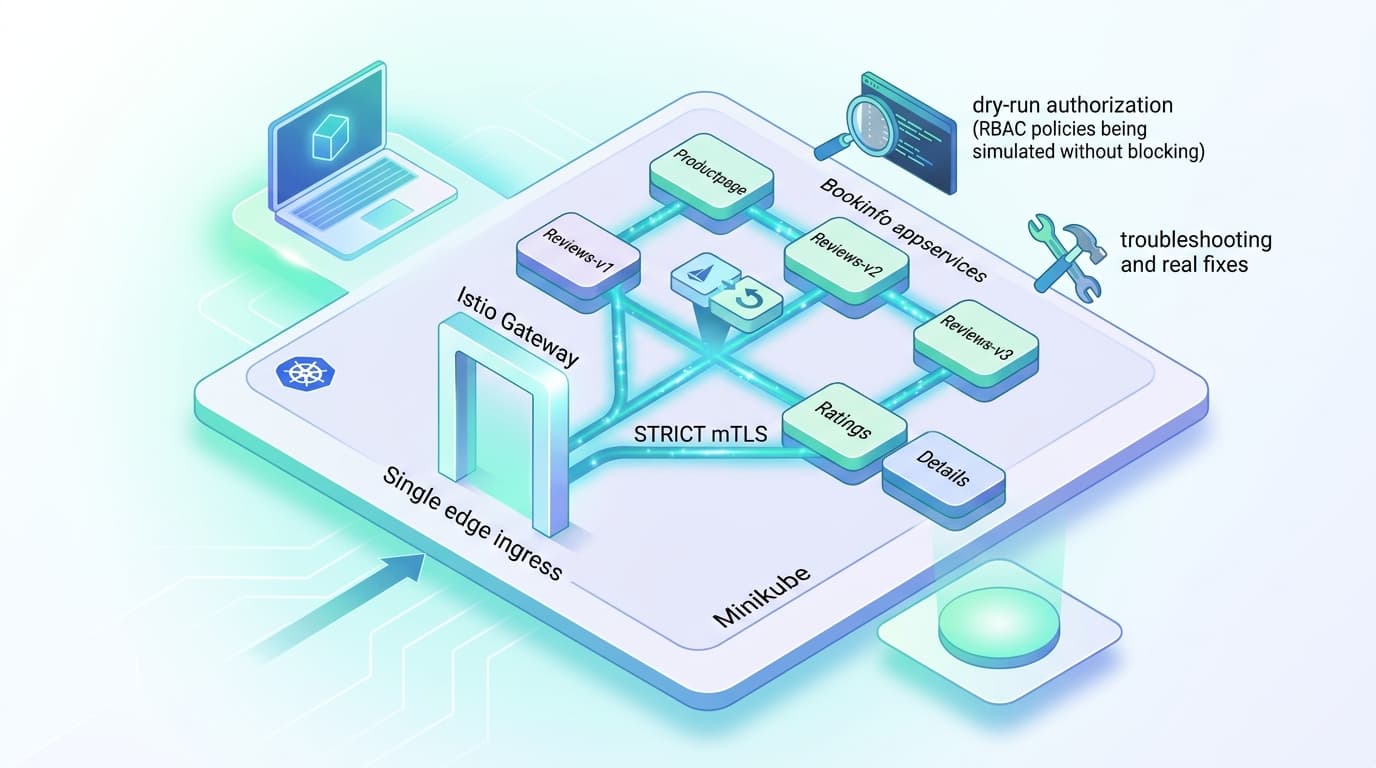
The site is a Next.js (opens in a new tab) app (services/www) with content in MDX and PostgreSQL. Two Python services sit next to it: a sandboxed Python practice executor and seo-agent, which runs every AI workflow as a CrewAI Flow. Everything runs in one namespace, jithendar, on a multi-node minikube cluster I call mk4.

The content pipeline has two edges into the site. CronJobs or admin buttons start flows. Flows write drafts back through the site's internal callback port (9465, never routed publicly). Publishing only happens when I approve a draft in the admin.
Edge and networking: Istio is the edge, not Kong
The edge has changed twice, and the commit history shows both changes.
It started on Traefik. In early November I prepared a Kong Gateway migration. The kong migration commit moved the Traefik manifests into a traefik-backup-conf/ folder, and the plan was a Kong instance in DB mode with its entities managed by decK. The SEO agent's MCP routes were even written as a decK file:
# minikube/kong/seo-agent-mcp.deck.yaml (excerpt)
routes:
  - name: jithendar-mcp-public
    protocols: [https]
    # Exactly /mcp/public and /mcp/public/… (a plain prefix would also match /mcp/publicXYZ).
    paths: ["~/mcp/public(/.*)?$"]
    strip_path: false
    # The MCP server validates Host (DNS-rebinding protection), so Kong must forward the original one.
    preserve_host: true
    # Do not buffer: SSE events must reach the client as they are written.
    request_buffering: false
    response_buffering: false
That file's own header reads "NOT APPLIED BY ANYTHING." Kong never became the site's edge. Traefik was uninstalled on 2026-11-09, and the Istio ingress gateway became the only edge, with its own wildcard certificate issued over DNS-01. The Kong plan was dropped. I kept the decK file because the routing ideas still apply (an exact-path regex, preserve_host, no buffering for SSE). The equivalent Istio route for /mcp/* is documented, but nobody has applied it yet.
Running one component as both ingress and mesh made the rest simpler. The site doesn't own the Gateway. It only contributes a delegate VirtualService: the root routing table (in the separate cluster repo) handles hosts, TLS, redirects and compression, and the site adds its default route:
# minikube/60-istio-routing.yaml (excerpt)
spec:
  http:
  - name: site
    headers:
      request:
        remove:          # a visitor must not choose their own trace id
        - traceparent
        - tracestate
        - baggage
    route:
    - destination:
        host: <site-service>  # in-cluster Service, redacted
        port:
          number: 80
Inside the namespace, mTLS is STRICT with no plain-text port. Even Prometheus scrapes :9464 through its own sidecar. An allow-known-callers AuthorizationPolicy admits only the gateway, the monitoring namespace and the namespace itself. It runs with istio.io/dry-run: "true" first, so it only counts what it would deny. It gets enforced once that count stays at zero.
EKS-style patterns on minikube
I spend my days on AWS EKS, so I copied the habits that matter there, even where minikube doesn't force them.
Namespaces and least-privilege CI. CI has two ServiceAccounts. github-ci-deployer may only restart and watch specific Deployments. github-ci-applier may apply application objects (Deployments, Services, ConfigMaps, NetworkPolicies, PDBs, VirtualServices) but never RBAC, Secrets, Namespaces or PeerAuthentications. That way a commit can't widen CI's own access. Nothing is ever pruned.
Secrets never in Git. scripts/create-secrets.sh creates the site Secret. Database and Valkey credentials are written by Terraform (opens in a new tab) in the cluster repo. Every script that changes the cluster sources scripts/lib/kube-context.sh, which prints the target context and API server and asks for confirmation unless KUBE_CONTEXT is set. On a laptop with several kubeconfigs, that guard has saved me more than once.
Availability basics. Two replicas, a PodDisruptionBudget, and a topology spread that is required:
# minikube/30-jithendar-com.yaml (excerpt)
topologySpreadConstraints:
- labelSelector:
    matchLabels:
      app: jithendar-com
  matchLabelKeys:
  - pod-template-hash
  nodeTaintsPolicy: Honor
  maxSkew: 1
  topologyKey: kubernetes.io/hostname
  # Required: with ScheduleAnyway both replicas once landed on one node,
  # so one node failure was a full outage.
  whenUnsatisfiable: DoNotSchedule
Hardened pods. Non-root, seccompProfile: RuntimeDefault, read-only root filesystems on the agent's trigger pods, dropped capabilities, and a NetworkPolicy per workload. Practice sandboxes run under a gVisor RuntimeClass with no network, pinned down by ValidatingAdmissionPolicies.
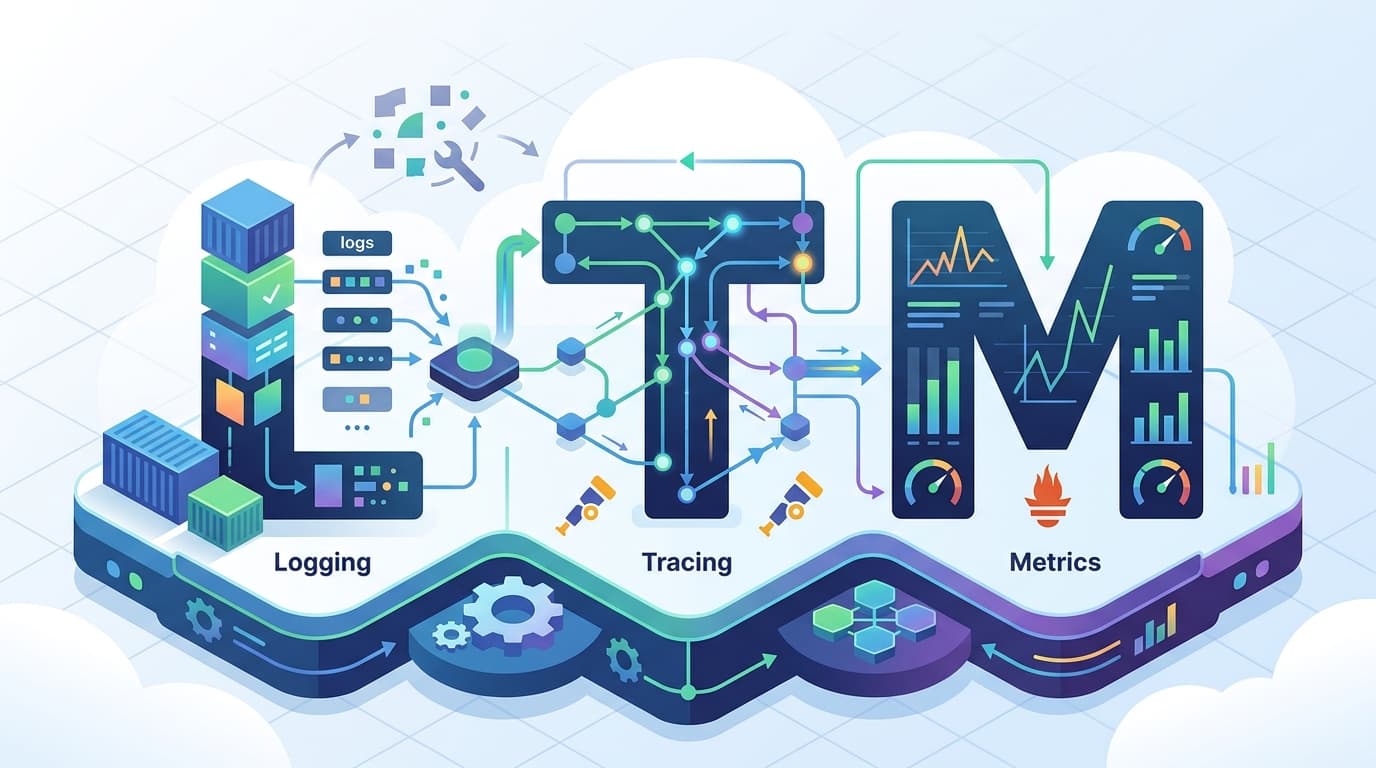
Observability. The site sends traces through @vercel/otel to an OpenTelemetry collector and on to Jaeger. JSON logs go to Loki through Alloy, and metrics go to Prometheus. Grafana dashboards live in the repo (services/grafana/) and reach Grafana through Argo CD. The collector keeps only allowlisted log fields and drops URLs, queries and SQL from traces.
Backups. Admin → Backups writes zip files to Cloudflare R2, optionally AES-256 encrypted with a passphrase only I know. They contain content, configuration and accounts, but no password hashes, sessions or stored credentials.
Where minikube differs from EKS. There's no managed control plane, so I restart the cluster after a host reboot myself (scripts/protect-host.sh installs a systemd unit for it). There's no IRSA: pods get credentials from Kubernetes (opens in a new tab) Secrets, not IAM roles. The registry is a self-hosted Harbor, not ECR. The Terraform for ECR and a GitHub OIDC role is still in infra/, but the release workflows push to Harbor. Every node shares one physical host, so "spread across nodes" protects against a node failing, not against the host failing. And Argo CD is only used for dashboards. The site itself deploys through CI and ./deploy.sh, not GitOps.
The AI content pipeline with CrewAI
seo-agent runs CrewAI 1.15. The design rule is in FLOWS.md: Flows orchestrate, Crews do the reasoning, plain Python does the data work. There's no other workflow engine. An earlier version used LangGraph (opens in a new tab), and v4 replaced it. Kubernetes CronJobs only trigger flows.
Crews and agents

| Crew | Agents (sequential) | Used by |
|---|---|---|
| Optimization | analyst → editor → reviewer | optimize_article_flow |
| Editorial | researcher → technical writer → technical reviewer → SEO editor | new_article_flow |
| Report | narrates weekly/monthly numbers | report_flow |
| Promotion | copywriter, strategist (no tools) | promotion_flow, content_ideas_flow |
Every crew shares the same guardrails (app/crews/common.py). allow_delegation=False, no code execution, no memory. Per-agent max_iter is 4, with a 150k-token cap per run and a 600-second wall clock. Tools come from a read-only allowlist: read_article, vector_search, Search Console queries, the style guide, and an SSRF-checked docs fetcher. No agent can write anything. Creating a draft is a flow step, never a tool. Article text and tool results reach the model wrapped as <data> blocks, and every backstory says that material is reference, not instructions.
The Editorial Crew has one detail I like: the SEO editor returns metadata only. The body that ships is the technical reviewer's corrected body, so the last agent can't rewrite the text after it has been checked.
Scheduling
Each scheduled flow has its own CronJob running python -m app.trigger <flow>. That script posts to /flows/{name}/kickoff with a service token, and that is all it does:
# minikube/seo-agent-60-flow-triggers.yaml (excerpt)
spec:
  schedule: "10 6 * * *"        # daily Search Console sync
  timeZone: Etc/UTC
  concurrencyPolicy: Forbid
  jobTemplate:
    spec:
      backoffLimit: 2
      activeDeadlineSeconds: 600
      template:
        spec:
          containers:
            - name: trigger
              command: ["python", "-m", "app.trigger", "gsc_sync_flow"]
Search Console and GA4 sync run daily. The technical audit, weekly recommendations, internal linking and reports run on Mondays. Reindexing and the ML jobs run on Sundays, and the news desk runs every 15 minutes. "Run now" buttons in the admin and the MCP kickoff_flow tool call the same endpoint, so there is one way to start a flow.
Run history and logs
Every run is a row in seo_flow_runs: status (queued, running, succeeded, failed, cancelled, paused_budget), the current step, the persisted state after each step, tokens, cost and the trigger. CrewAI's default local SQLite persistence is replaced by a Postgres-backed FlowPersistence. A partial unique index and a Postgres advisory lock allow only one active run per flow and target. If a pod crashes mid-run, the run isn't resumed. On startup it is marked failed, and because every step is idempotent, a rerun starts clean. Every model call writes a seo_llm_usage row and an OTel span named crew.<crew>.<agent>.
The human gate
This is the part I care about most. Drafting flows end at "draft awaiting review." publish_flow can only start from a human approval, and it checks that again itself:
# services/seo-agent/app/flows/publish.py (excerpt)
@start()
async def apply_changes(self) -> None:
    async with self.step("apply_changes"):
        s = self.state
        if s.triggered_by != "approval":
            # Defence in depth: the runner already refuses this;
            # a flow must never publish on any other trigger.
            raise PermissionError("publish_flow runs only from a human approval")
The review queue shows each draft as numbered changes in a word-level diff, with the evidence behind each one. I accept or reject them one at a time. There is no bulk approve. A "Needs fact check" flag marks commands or versions without a cited source, and a "Blocks approval" flag must be resolved before publishing. After approval, the flow publishes, verifies the live page, and offers a rollback if that check fails. New articles from the editorial calendar go into a CMS draft post and wait for the editor's own Publish button.
The SEO dashboard (formerly /admin/seo)
The dashboard started at /admin/seo. It has since been merged into the main CMS, so those URLs now redirect to pages like /admin/search, /admin/keywords, /admin/recommendations, /admin/technical and /admin/review.
It reads Google Search Console and GA4, runs a technical audit with an SSRF-safe crawler limited to my own host, and turns the data into scored recommendations. The score is a weighted average over up to six normalised inputs: search opportunity (30), ranking opportunity (20), relevance (20), quality gap (15), trend (10) and effort (5). Inputs a rule can't compute are left out and the remaining weights renormalised, and the UI shows which inputs were used. The rules behind those inputs cover low CTR, striking-distance queries (positions 5–20), decay, content gaps, outdated content and internal links.
For content suggestions, the weekly flow takes the top-scoring articles without an open draft and fans out at most two optimization runs at once. The Promotion page scores each article per channel, with drafted posts I copy and post myself (there is no posting code). It also suggests new topics with evidence from Search Console demand and Reddit threads. An idea goes to the editorial calendar and then through the Editorial Crew to my review.
CI/CD: tagged by PR number, built only on merge

Every workflow runs on pull_request and starts its release job only when the PR is merged into the default branch:
# .github/workflows/ci-jithendar-com.yml (excerpt)
on:
  workflow_dispatch:
  pull_request:
    types: [opened, synchronize, reopened, closed]
# ...
    if: github.event_name == 'pull_request' && github.event.action == 'closed'
        && github.event.pull_request.merged == true
        && github.event.pull_request.base.ref == github.event.repository.default_branch
# ...
    env:
      PR_TAG: pr-${{ github.event.pull_request.number }}
      RELEASE_SHA: ${{ github.event.pull_request.merge_commit_sha }}
The release job builds from the merge commit, not the PR's test merge. It runs lint, tests and the production build on a native arm64 runner, fails if the image grew more than 15% over a stored baseline, and smoke-tests the container (health version must match the commit, the image optimiser must return AVIF or WebP). Then it pushes :pr-<number> and :latest and restarts the Deployment.
There's no push trigger, on purpose. Every release maps to a reviewed PR, and its tag is the rollback handle: kubectl set image ... :pr-<n>. A stray push to master deploys nothing. Two exceptions run on push: ci-content.yml, which ships articles and images as a small content image, and infra.yml, which applies Terraform.
What broke
CI froze the host (2026-10-29). Builds ran on self-hosted runners on the same machine as the cluster, and they competed for memory and disk until the host froze. Capping the runners' cgroup wasn't enough, because docker build runs inside dockerd, outside that cgroup. The fix was to move builds to GitHub-hosted runners. protect-host.sh also adds swap, a persistent journal and a cluster-start unit.
Both replicas on one node. With whenUnsatisfiable: ScheduleAnyway, the scheduler put both pods on the same worker, so one node failure meant a full outage. The fix was DoNotSchedule plus matchLabelKeys: [pod-template-hash] and nodeTaintsPolicy: Honor.
Sidecars that never got ready (2026-11-08). Once NetworkPolicies isolated the pods, a pod with no DNS egress rule of its own timed out resolving istiod, and its sidecar never became ready. With holdApplicationUntilProxyStarts, the app never started either. The fix was a shared istio-sidecars NetworkPolicy allowing DNS to kube-dns and port 15012 to istiod.
A squash merge corrupted uv.lock. PR #33 appended a second identical copy of the scikit-learn and scipy blocks, so uv sync --frozen failed and every seo-agent CI run broke at install. The broken install also hid a real bug: a forced reindex never deleted chunks of unpublished articles, and the test that would have caught it never ran. Both were fixed in PR #35.
OOM headroom. At a 1Gi limit, the site used 780–874Mi, too close to the limit, since an OOM kill drops a replica mid-request. The limit is now 1536Mi.
Cost and what I'd do differently
The repo tracks LLM spend, not hardware spend. The admin AI budget defaults to $15 a month, against an estimate of about $8–10.50. That breaks down to roughly $0.12–0.15 per article optimisation and $0.25–0.45 per new-article draft, with reports under a cent. Ask the Blog has a separate $1/day cap. A call that could cross the cap is never sent: the run ends paused_budget and an alert fires at 80%. The crews cost about 3–4× the earlier single-call drafting. That's the price of the researcher/writer/reviewer split, and the per-agent model override (the analyst runs on Haiku) is the lever for lowering it.
What I'd do differently:
- Build off the cluster host from day one. The freeze was avoidable.
- Pick the edge once. Moving from Traefik to Kong to Istio cost a branch, a backup folder and an unapplied decK file.
- Make topology spread required from the start. "Soft" spreading looks fine until you check where the pods actually landed.
What's next
From the repo's own TODOs: take the allow-known-callers AuthorizationPolicy out of dry-run, add the /mcp/* routes to the Istio root VirtualService so the MCP servers become reachable, and move the LLM budget reservation to work across replicas (today it is in-process only).
Key takeaways
- A personal site is a good way to rehearse platform work, because it has every production concern at a scale you can reason about.
- Use one edge you understand. Istio as both ingress and mesh removed a whole layer for me.
- Give CI the narrowest RBAC that works, and keep RBAC, Secrets and mesh policy changes for a person.
- In an AI pipeline, agents should only read. Writes are flow steps, and publishing needs a human trigger, checked twice.
- Tag images by PR number and release only on merge. Every deploy then has a review, a commit and a rollback tag.

Discussion comments
No comments yet. Start the discussion.