I run four AI systems on one Minikube cluster. They do different jobs: one investigates production incidents, one fronts a shop, one exposes that shop to MCP clients, and one recommends products. They share one rule.
The model proposes, code decides. The language model receives evidence that has been redacted and wrapped in tags marking it as untrusted. It returns requests (tool calls, a plan, a list of SKUs) or text. It never holds credentials. Code decides what is in scope, who may do what, how much may be spent, and whether anything changes in the world.
The platform
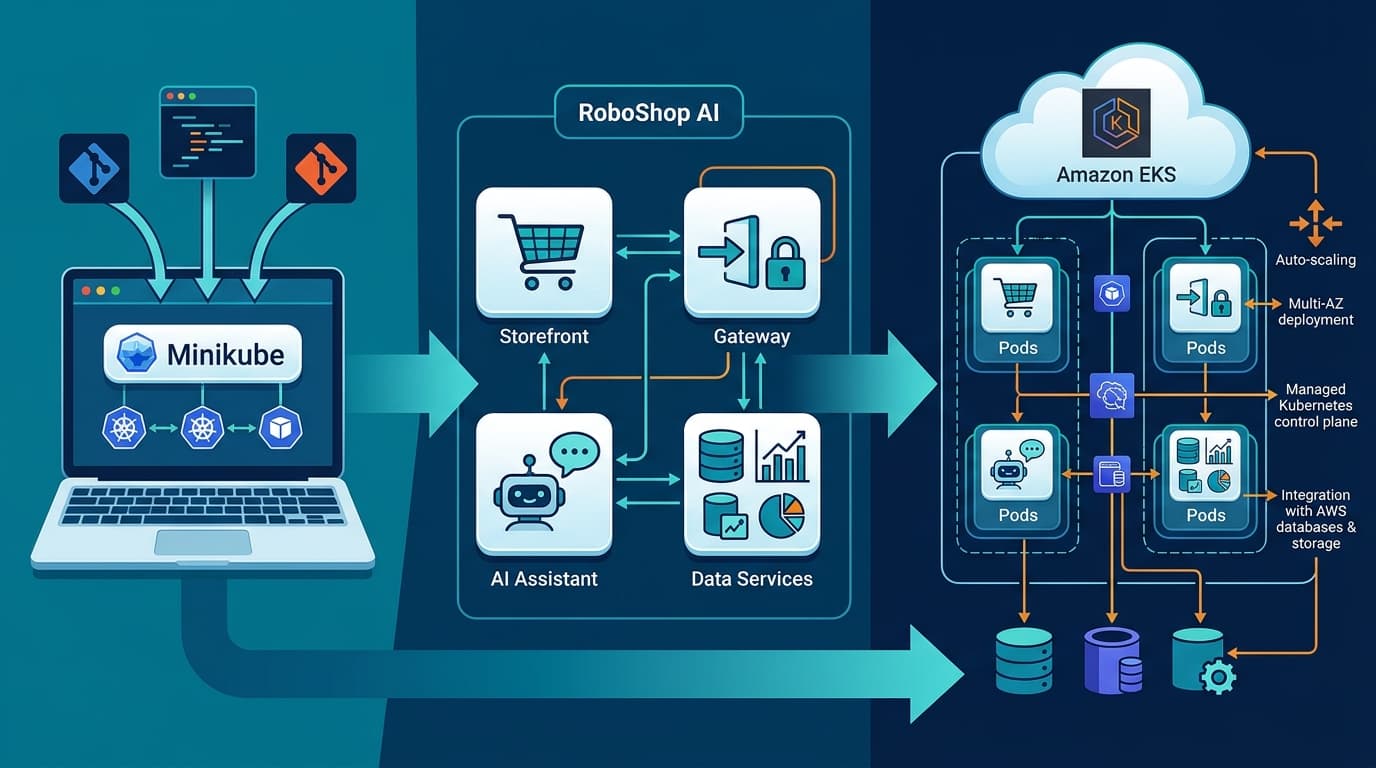
Everything runs on mk4, a Minikube cluster on a single arm64 server. Argo CD delivers both projects. MOKS has a root Application plus one per component (moks-api, moks-worker, moks-executor, moks-crewai and so on, see moks/docs/ARGOCD_APP_SPLIT.md). RoboShop has one roboshop-<app> Application per service, with manual sync and no pruning (roboshop-ai/argocd-minikube/README.md).
Images come from my own Harbor registry, registry.jithendar.com/jithendar/<image>:latest. CI builds and pushes them on every push to master. For telemetry, services send OpenTelemetry traces to a collector and on to Jaeger, Prometheus scrapes metrics, and Alloy ships JSON logs to Loki. MOKS also reads that same Prometheus and Loki as evidence. That matters during an incident: if Loki is down, MOKS loses its own logs and a source of evidence at once.
The RoboShop services themselves (catalogue, cart, payment, shipping, the event pipeline) are covered in Inside RoboShop AI: microservices on Kubernetes. Here I only cover the AI parts.
flowchart LR
  B["Browser"] -->|"HTTPS"| T["Traefik"]
  T -->|"/roboshop"| WEB["web"]
  WEB -->|"widget /chat"| MK["Moks<br/>shopping agent"]
  MK -->|"/api/chat<br/>service token + user session"| GW["ai-gateway<br/>only public API"]
  GW -->|"/internal/chat<br/>config snapshot + evidence inputs"| MK
  MK -.->|"redacted prompt"| P1["Bedrock or Ollama"]
  C["MCP client<br/>(port-forward)"] -->|"POST /mcp<br/>Bearer = caller's session"| MCP["mcp-server<br/>ClusterIP only"]
  MCP -->|"caller's own rs_auth"| GW
  T -->|"/moks"| API["MOKS api"]
  API --> PG[("PostgreSQL")]
  W["MOKS worker"] --> PG
  W -->|"read-only"| K["Kubernetes API · Prometheus · Loki"]
  W -.->|"redacted evidence"| P2["LLM provider"]
  X["MOKS executor<br/>approved plans only"] -->|"scoped writes"| K
All four systems and who calls whom. Dotted arrows are the only places a model is involved; every solid arrow is checked by code.
MOKS: the SRE investigation agent
You ask MOKS "Why is checkout returning 502 errors?". It collects live evidence through typed, read-only tools and returns a report that keeps observed facts, suspected causes, missing evidence, next steps and proposed remediation apart.
Components
| Component | Role |
|---|---|
moks-api (×2) | FastAPI: the React portal, REST API, server-sent events, sign-in |
moks-worker | Claims queued investigations (FOR UPDATE SKIP LOCKED) and runs them |
moks-executor | The only process with write credentials, with its own ServiceAccount bound per namespace |
| PostgreSQL | The only system of record: users, RBAC, investigations, evidence, audit |
| OpenSearch | Optional knowledge index; derived data that can be rebuilt from PostgreSQL |
The API and worker cannot even construct the writer: a MOKS_PROCESS_ROLE guard stops them (docs/SECURITY.md). The in-cluster moks-reader ClusterRole has no write verbs and no Secrets, ConfigMaps, pods/exec, pods/attach or pods/portforward.
The investigation loop
An investigation is a LangGraph state machine (backend/moks/orchestrator/graph.py). The graph only decides what runs next; every node calls an Investigator method, and every live read goes through one ToolExecutor.
flowchart LR
  I["intake<br/>intent + targets"] -->|"troubleshoot"| KN["knowledge"] --> TR["triage"] --> LG["logs"] --> SK["skills"] --> RF["refresh"]
  I -->|"guidance"| GA["gather"] --> CO["compose"]
  I -->|"conceptual"| CC["concept"]
  RF -->|"model configured"| PL["plan"]
  RF -->|"no model"| RU["rules"]
  PL -->|"tool_calls"| AC["act"] -->|"more work"| PL
  PL -->|"LLM error or budget"| RU
  PL -->|"done or limit"| CR["correlate"]
  AC -->|"finished"| CR
  RU --> CR --> RE["report"] --> V["validate_claims<br/>verify_causes"]
The MOKS investigation graph. The model is only consulted in plan and report; with no model, or after a model failure, the rules path still produces a report.
In plan, the model sees the question, the scope, the tool schemas and the evidence so far, all inside randomly tagged <untrusted_data> blocks. It answers in MOKS's own JSON protocol: {"tool_calls": [...], "done": bool}. Each call is checked against the tool allowlist, the argument schema, RBAC, scope and size bounds before any connector runs. A rejected call is audited and fed back so the model does not repeat it.
Limits are enforced in code (backend/moks/config.py, docs/ARCHITECTURE.md):
| Limit | Value |
|---|---|
| Tool calls per investigation | 16 by default; values.yaml sets 24 on mk4 |
| LLM planning rounds | 4 |
| Duration | 180 s, via asyncio.timeout |
| Stored result size | 48,000 bytes, truncated structurally |
| Tokens per investigation | 60,000 |
| Cost | Daily USD budget per LLM configuration, plus per-user and per-investigation budgets |
Every model call reserves its worst-case cost before it runs (moks/llm/budget.py). If the model fails or the budget runs out, MOKS falls back to rule-based follow-ups (logs of crashed pods, memory against limits, recent rollouts) and says so in the report. An unavailable connector becomes a "missing evidence" item, not a failure.
The evidence ledger and claim validation
Every tool result is stored as a numbered evidence row, E1 to En, with the tool, arguments, scope, the exact query, timing and the redacted data. The report has to cite those rows. This is the contract (backend/moks/orchestrator/report.py, trimmed):
class Cause(BaseModel):
    cause: str
    confidence: Literal["low", "medium", "high"] = "low"
    evidence: list[str]       # E-refs, checked against the ledger
    verified: bool = False    # set only by verify_causes; never by the model

class Report(BaseModel):
    summary: str
    observed_facts: list[Fact]                 # each {statement, evidence[]}
    suspected_causes: list[Cause]
    missing_evidence: list[str]
    next_steps: list[str]
    proposed_remediation: list[Remediation]    # executable=False, always
    generated_by: Literal["llm", "rules"] = "rules"
After the model writes the report, code validates it. Facts with no real evidence reference are dropped. Causes without evidence fall to low. "Confirmed" or "resolved" wording gets an explicit "unverified" note. A model's cause is never marked verified, whatever its confidence. Verified causes come only from five detectors that observe the fault directly: service_selector_mismatch, oomkilled, image_pull, unschedulable and config_ref_missing.
Two layers of authorization
Access is the intersection of two independent controls (docs/SECURITY.md):
- Application RBAC. Bindings of the form
role : environment-pattern : namespace-pattern, for roles from viewer up to admin. - Infrastructure scope. Each environment has allowed and denied namespace lists that apply to everyone, administrators included, and the connector's own Kubernetes RBAC narrows it further.
The effective scope is RBAC ∩ allow-list − deny-list. It is checked in the API, again when the worker picks up the job, and again in the executor on every tool call, including calls the model planned. Free-form LogQL must pin namespace="<permitted>" in every selector. Revocation reaches running work within 5 seconds: the investigation compares version counters before every tool call, before every LLM request, and every 5 seconds.
Action plans, approvals and at-most-once execution
MOKS reports never execute anything. Changes go through action plans: an allowlist of restart_deployment, scale_deployment, rollback_deployment, patch_resources, apply_config_patch and open_pull_request. A plan is bound by SHA-256 to the environment, namespace, action, target, parameters, requester, expiry and the target's resourceVersion. Approvers submit the hash they reviewed, and the requester cannot approve their own plan.
The executor re-checks everything right before acting. It requires the live resourceVersion to equal the reviewed one, writes an intent checkpoint, mutates once, reads the result back and records applied. If the outcome is uncertain, the plan goes to reconciliation_required for a person to decide. Nothing is ever replayed.
One exception is stated plainly in the docs: a global administrator can approve their own plans, which removes separation of duties for that role. Each waiver is audited as action.approval_waived.
The hash-chained audit log
audit_events records sign-ins, denials, every tool call (allowed and denied) and every configuration change. Database triggers reject UPDATE, DELETE and TRUNCATE. A BEFORE INSERT trigger sets hash = sha256(prev_hash | seq | row content), and moks verify-audit recomputes the chain. The docs call this tamper-evident, not tamper-proof: a database superuser could disable the triggers and rewrite the whole chain consistently. Shipping checkpoints off-cluster is the documented fix.
The opt-in CrewAI flow
For one question, "why is this workload unhealthy?", MOKS can run three CrewAI agents in sequence instead of the LangGraph loop (docs/crewai-investigation.md):
- A workload investigator with nine read-only tools (pods, events, logs, metrics, alerts).
- A change investigator with rollout history, config audit, Git commits and runbook search.
- An incident reviewer with only
evidence_list, which returns the JSON findings.
The 14 investigation tools are read-only and go through the same ToolExecutor, so each call becomes an evidence row. The reviewer's evidence_list only reads what has been recorded. The model supplies only narrow arguments. The environment, namespace, workload and time window are bound from the investigation, and a pod outside <workload>-… is refused. After the crew finishes, code rejects citations that are not in the registry and removes findings left with none. It also caps confidence: low with no live evidence, at most medium with one source, and high only with two. The usual validate_claims and verify_causes then run as they do for every report.
CrewAI sends anonymous telemetry by default. MOKS turns it off before importing crewai, and a test fails if a run resolves any non-local host. Memory, knowledge and planning are off, because each would call a provider of its own. CrewAI runs in its own worker Deployment, moks-crewai, so its 76 extra packages stay out of every other pod.
The AI gateway
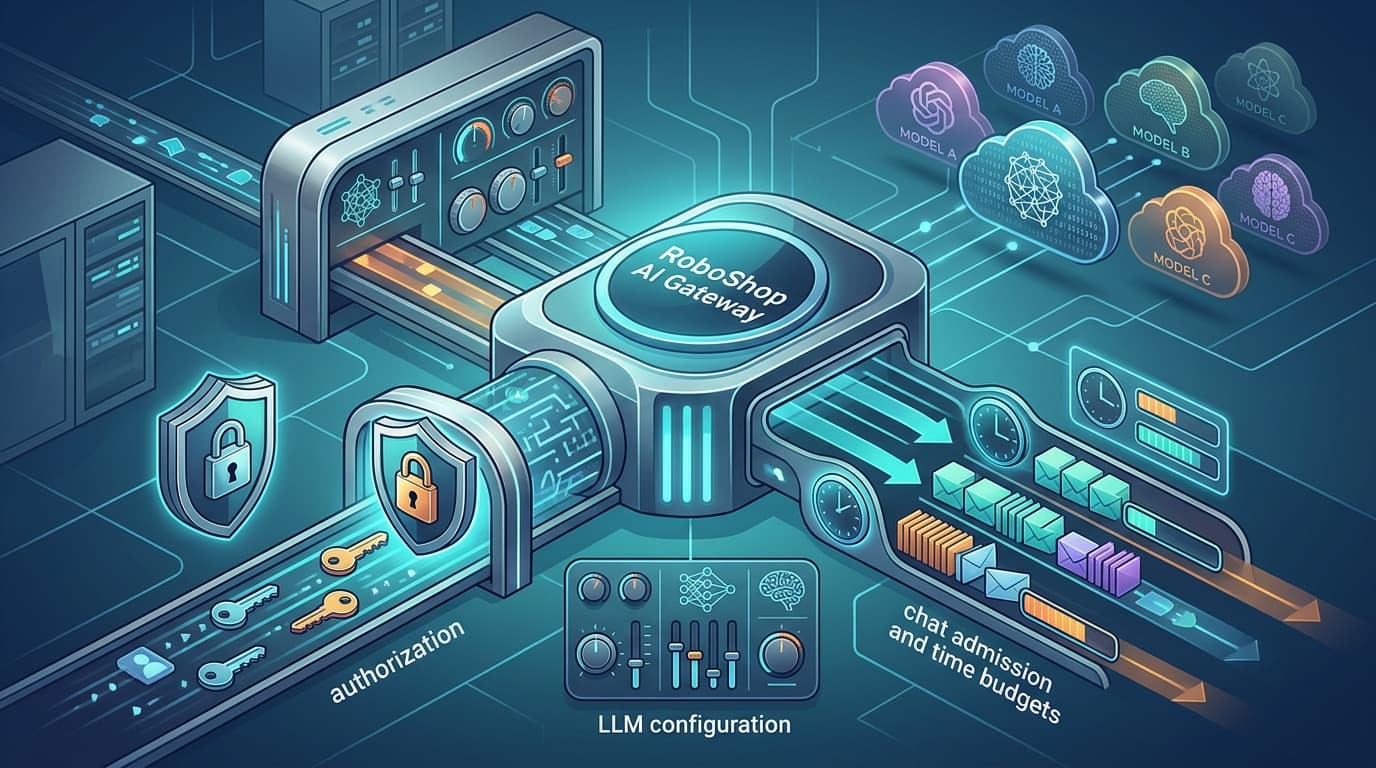
ai-gateway is RoboShop's only public API. Browsers never talk to a backend service directly. It has its own article, so this is the short version (services/ai-gateway/README.md).
- Authentication is delegated.
user-serviceowns users and hashed sessions, and the gateway forwards to it. Session checks fail closed if that service is down. - Mutations are origin-checked. State-changing requests fail with 403 "Origin not allowed" from a foreign origin. Cookies are
HttpOnly,SameSite=StrictandSecureon HTTPS. - Orders follow a state machine.
creating → payment_pending → paid, withpayment_reviewwhen a provider's answer is unknown. A retry reconciles by receipt and never creates a second provider order. The payment details are in the microservices article.
The super admin owns the LLM. A fresh install has no model: chat answers "Please connect an LLM to get results." with code: LLM_NOT_CONFIGURED, and the gateway returns that before calling Moks at all. Only a super admin can save a provider, and saves are revision-checked and audited. Bedrock uses the workload's IAM credential chain, never keys typed into a UI. Ollama endpoints must be allowlisted by the deployment. Automatic Ollama-to-Bedrock failover is opt-in, and it only commits if both providers pass a connection test.
Readiness never depends on AI. /health/ready probes MongoDB, the catalogue, the user service, the ledger writer and Redis carts, within a 1.5-second budget. It never calls a model, recommendations, payment or telemetry. If AI is broken, chat returns 503 feature-unavailable while browsing, cart and checkout keep working.
The gateway also admits chat through a fixed pool of slots. When they're full it returns 429 assistant-busy with Retry-After: 5, which is a different outcome from a failed provider.
The MCP server
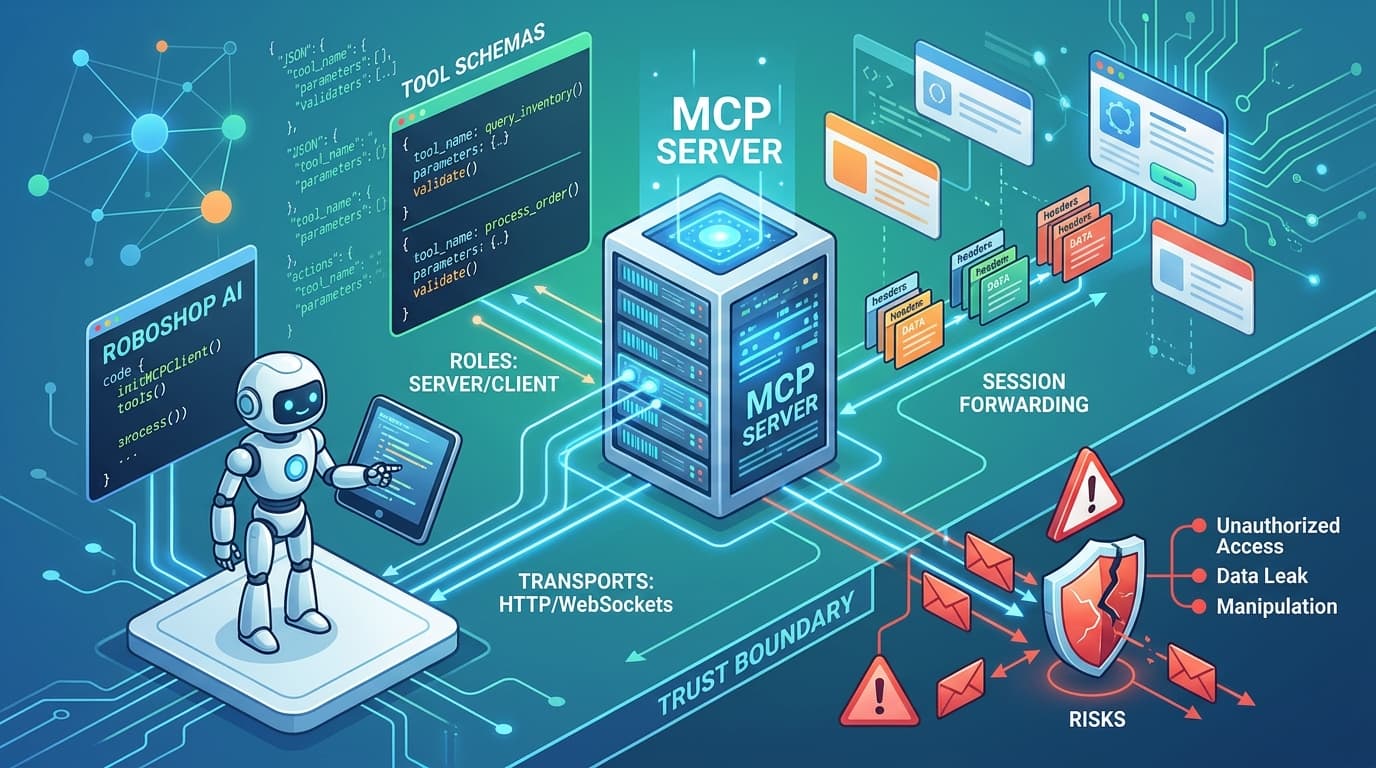
mcp-server lets MCP clients (Claude, an IDE, a script) search, compare and shop the catalogue as a signed-in user. It uses FastMCP 4.1.3 on MCP Python SDK 2.3.0. The deep-dive has the walkthrough; these are the boundaries (services/mcp-server/README.md).
Transport and identity. It speaks Streamable HTTP (POST /mcp, stateless) in the cluster and stdio for local clients. The Service is ClusterIP only, and a NetworkPolicy admits only pods labelled roboshop.ai/mcp-client: "true". No workload carries that label today, so access is by port-forward. Every HTTP request carries Authorization: Bearer <session>, an ordinary opaque RoboShop session that is checked against /api/auth/me on every request, with no cache. Toward the gateway, the server sends only accept, the caller's own rs_auth cookie and trace headers. The gateway then authorizes the call again.
Why it must stay private. This is not OAuth. A remote client over the internet needs MCP authorization with OAuth 2.1 against an external identity provider, plus TLS. That isn't built, and the README says not to expose /mcp publicly without it.
Tools. Every tool has a strict input schema (no unknown fields, no type coercion, bounded sizes) and a declared output schema that the result must pass before it is returned.
| Kind | Tools | Notes |
|---|---|---|
| Read (10) | search_products, compare_products, shipping_countries, shipping_cities, service_health, personalized_recommendations, view_cart, admin_list_products, admin_list_users, admin_get_settings | Read-only and idempotent; retried once, only on connection failure, timeout or 502/503/504 |
| Write (1) | update_cart | Sets one line in the caller's own cart; never retried |
| Admin write (4) | admin_create_product, admin_update_product, admin_set_user_access, admin_update_settings | Not registered unless MCP_ENABLE_ADMIN_WRITES=true |
There are no tools for orders, payments, refunds, deletion or infrastructure, and no tool takes a URL, SQL or a shell command.
Confirmation for admin writes. A confirm: true argument chosen by the model never counts. The first call returns an MCP elicitation request. Its state names the caller, the tool, a hash of the exact arguments, a two-minute expiry and a one-time nonce, all HMAC-signed. The retry proceeds only if that state verifies, is unexpired and unused, matches the same identity and arguments, and carries accept with confirm: true. This proves the confirmation came through the authenticated client; it can't prove a human clicked. That's why admin writes are off by default.
Errors and limits. Tool failures come back as isError: true results with one structured shape:
{"error": {
  "code": "conflict",
  "message": "<public message>",
  "retryable": false,
  "correlationId": "<trace id>"
}}
Codes include invalid_argument, unauthenticated, forbidden, not_found, conflict, rate_limited, dependency_unavailable, invalid_response, timeout and three confirmation_* codes. retryable is never true for a write. Admission is 60 calls per minute per user and 32 in flight. Each tool call has a 10-second deadline, retries included, and bodies over 256 KiB get 413. One W3C trace runs from the client's traceparent through POST /mcp, the session check, mcp.call_tool, the gateway call and the gateway itself. Span attributes come from an allowlist, so arguments and session IDs are never exported.
Why Moks doesn't use MCP. The gateway calls Moks for /api/chat. If Moks reached the catalogue through MCP, the path would be gateway → Moks → MCP → gateway: a loop that adds a hop and no authorization.
Moks: the shopping agent
Moks is the widget in the corner of every RoboShop page. It is a fixed pipeline, not a tool-using agent: no loop, no cart, no checkout. The shopping-agent article traces a conversation through it (services/moks/README.md).
The graph is three nodes in a line (services/moks/agent.py):
START → search_catalogue → ground_evidence → generate_answer → ENDRetrieval is deterministic. Hard filters run before ranking: archived and sold-out listings, an explicit currency (with no conversion), the budget, and "in stock" wording that excludes reference and showcase listings. Budgets parse formats like under INR 5,000, below ₹5000 and Indian grouping (1,00,000). Two currencies or two amounts get a clarifying question instead of a guess. At most four products become evidence, and the model sees only those.
Cards are validated. The model must end with Products: <SKUs> or Products: none. Moks keeps only SKUs that were in the evidence, strips the line, and returns at most three cards in the model's order. Unknown SKUs are dropped and counted as validation failures. The gateway then re-applies live stock before the widget shows today's price.
Follow-ups cost no model call. "Which of those is cheaper?", "compare the first two" and "only under INR 5,000" are resolved deterministically against the last saved product references and today's catalogue. Ambiguous references get one deterministic question. History is capped at 4,000 characters and the prompt at 14,000, and the current question is never truncated.
Deadlines and failure. Each request has a 16-second retrieval and inference budget (server.py, routing.py). Each provider attempt is capped at 6 seconds when failover is on (12 seconds otherwise), with at most one fallback after an eligible transport failure. A per-replica circuit breaker opens after 3 failures for 30 seconds, then allows one half-open call. OpenTelemetry and optional Langfuse record metadata only (retrieval mode, candidate count, cards, token usage), never prompts or replies.
Why no embeddings yet. On this catalogue, the measured retrieval failures were word forms, generic words and references, not missing meaning. So the work went into word matching (whole words, plurals, suffixes, ignoring generic words) rather than a vector store. The README says to revisit if evaluations show paraphrase misses that synonyms can't cover.
Shared patterns
| Pattern | MOKS | AI gateway | MCP server | Moks |
|---|---|---|---|---|
| Untrusted data | Random-tagged <untrusted_data> blocks | Passes history as a separate field | No tool takes URLs, SQL or shell | History and catalogue text are data |
| Citations | E-refs; uncited facts dropped | n/a | Output schema per tool | Products: SKUs must be in evidence |
| Budgets | Tool calls, rounds, 180 s, tokens, USD | Chat slots, 23 s downstream budget | 10 s deadline, 60/min, 32 in flight | 16 s, per-attempt cap, breaker |
| Fail-closed auth | RBAC ∩ scope, re-checked per call | Session check fails closed | Session check per request, no cache | Signed-in user and allowed Origin |
| Optional AI | rules path without a model | No LLM by default; readiness ignores AI | Never calls a model | Widget hides; shopping unaffected |
| Observability without prompts | Spans record names and codes | Category-only logs | Allowlisted span attributes | Metadata-only spans |
What's not proven yet
These come straight from moks/docs/LIMITATIONS.md, docs/crewai-investigation.md and the READMEs.
MOKS
- Phase 1 (sign-in, RBAC, the portal, Kubernetes, Prometheus and Loki tools, cited investigations, audit) is verified live, except streaming through the ingress.
- Phase 3 actions are tested with fakes only. No action plan has run against a real API server.
- Phase 4 (alert-triggered investigations) is tested with fakes and hasn't run on mk4 since the rewrite.
- The docs record that no chat model has answered a live MOKS request. Gemini embeddings have run live; Bedrock has no AWS keys on mk4.
- Claim support is identifier overlap, not meaning: a well-formed false sentence about the right resource can pass.
- The Kubernetes connector shares one ServiceAccount across users, so isolation between users rests on MOKS's own checks.
- All mk4 nodes share one disk, and there is no point-in-time recovery.
CrewAI flow
- No real model has run the crew. Small models may not follow CrewAI's Action/Observation text format.
- The
moks-crewaiworker is deployed on mk4, but the demo smoke test hasn't run. - A CrewAI run writes no checkpoints, so a dead worker means a failed run rather than a resumed one.
Gateway
- The JSON order ledger is one process, one replica, with
strategy: Recreate, so upgrades briefly interrupt it. A PostgreSQL ledger exists behindCOMMERCE_BACKEND=postgresbut isn't the default. - There is no automatic cancellation, reservation expiry or refund flow.
- The LLM status checks are model-list and TLS checks, not proof that generation will work.
MCP server
- There's no OAuth, so it's private only.
- Every HTTP user shares the gateway's per-address limit of 300 requests a minute.
- Confirmation nonces live in memory: they are single-use within one replica only and are lost on restart.
Moks
- The quality of real model prose is unverified until it has been scored with the human rubric.
- Prefix matching can over-match ("card" and "cardboard").
- References look only at the most recent turn that showed products.
What I'd do next
- Run the MOKS executor against a real API server. It's the one write path in the system, and today it has only met an in-memory writer.
- Run CrewAI on mk4 with a real model. That means
scripts/crewai-demo.shand its two broken workloads, then checking that the injected log line changes nothing. - Cut the gateway over to the PostgreSQL commerce ledger. The README is explicit that a transactional database and outbox are needed before the gateway can scale past one replica.
- Add OAuth 2.1 before any remote MCP access. That needs an external identity provider and TLS, and it's the precondition for letting a client outside the cluster connect.
- Score Moks with the human rubric. Then decide on embeddings using measured paraphrase misses, not by default.
Code and live apps
- MOKS: github.com/mrjithendar/moks, live at jithendar.com/moks (sign-in required)
- RoboShop AI: github.com/mrjithendar/roboshop-ai (
services/ai-gateway,services/mcp-server,services/moks), live at jithendar.com/roboshop - Deeper reading: the gateway, the MCP server, the shopping agent, LangGraph in MOKS and MOKS observability
Discussion comments
No comments yet. Start the discussion.