The RoboShop AI gateway is the one service every API request passes through. It authenticates callers, owns the order ledger, stores the active LLM configuration and admits chat requests to the shopping agent. It does not call a language model. There is no model SDK in its dependencies, and that is the first thing to understand about it.
Many products sold as "AI gateways" are proxies that sit in front of model providers, adding keys, caching and token budgets. services/ai-gateway is a different thing. It is the store's public API with an AI control plane attached. All inference happens in Moks, and the gateway's job is to decide whether Moks gets called, with what, and for how long.
This article assumes you have the shape of the system from the architecture overview. It describes commit c81e85a.
How it differs from an ingress, a proxy and an API gateway
These terms get used loosely, so here is what each layer does in this system.
| Layer | In RoboShop AI | Understands | Does not know |
|---|---|---|---|
| Load balancer | AWS Network Load Balancer | TCP | HTTP paths |
| Ingress | Istio ingress gateway | TLS, hostnames, /roboshop prefix | Users |
| Reverse proxy | NGINX inside web | Paths, timeouts, security headers | Sessions or roles |
| API gateway | ai-gateway | Sessions, roles, Origin, rate limits | Model internals |
| AI control plane | Also ai-gateway | Active provider, history, stock filter | Prompts or token counts |
| LLM client | moks, not the gateway | Bedrock, Ollama, retries, failover | Who the user is |
The reverse proxy adds one hard rule worth seeing. NGINX refuses to let a browser reach chat directly:
# services/web/nginx/snippets/routes.conf
location = /api/chat { return 403; }
Browsers use /moks/chat, which NGINX proxies to the widget half of Moks. So /api/chat is callable only from inside the cluster, and the gateway separately demands a service token, which gives two independent barriers.
Endpoints and internal modules
The gateway is a FastAPI application with very few declared routes. asgi_app.py registers /api/chat, /api/admin/llm/status, /health/live, /health/ready and a catch-all, and nearly everything goes through Gateway.route in server.py, a long hand-written dispatcher. FastAPI supplies the server, the OpenAPI document and the middleware. It does not do the routing.
| Route | Who calls it | What it does |
|---|---|---|
POST /api/chat | Moks widget, with service token | Runs one assistant turn |
GET /api/chat/history | Moks widget, with service token | Returns the user's saved turns |
GET /internal/llm/config | Moks engine | Returns the active config and revision |
GET, PUT /api/admin/llm | Super admin | Reads or saves provider settings |
POST /api/admin/llm/test | Super admin | Tests a proposed provider |
POST /api/admin/llm/disconnect | Super admin | Turns the assistant off |
GET /api/status | Moks widget health check | Reports assistantMode, checkoutMode |
GET /api/products, /api/compare, /api/cart | Browser, MCP server | Commerce reads and writes |
/api/auth/*, /api/account/* | Browser | Forwarded to user-service |
/api/payments/* | Browser, Razorpay | Checkout state machine |
| Module | Responsibility |
|---|---|
asgi_app.py | Transport: body limits, worker slots, deadline, error mapping, metrics |
server.py | Domain routing and authorization |
api_models.py | Pydantic request and response contracts |
llm.py | LLM configuration, revisions, audit trail |
lib/llm_config.py | Strict config validation, service token checks |
chat_history.py | Per-account conversation storage |
user_client.py | Calls to user-service |
store.py, postgres_store.py | JSON and PostgreSQL order ledgers |
readiness.py | Bounded dependency probes |
lib/runtime.py | HTTP clients, retries, tracing, structured logging |
Following one chat request
Figure 1 shows POST /api/chat, with the response each step gives when it refuses.
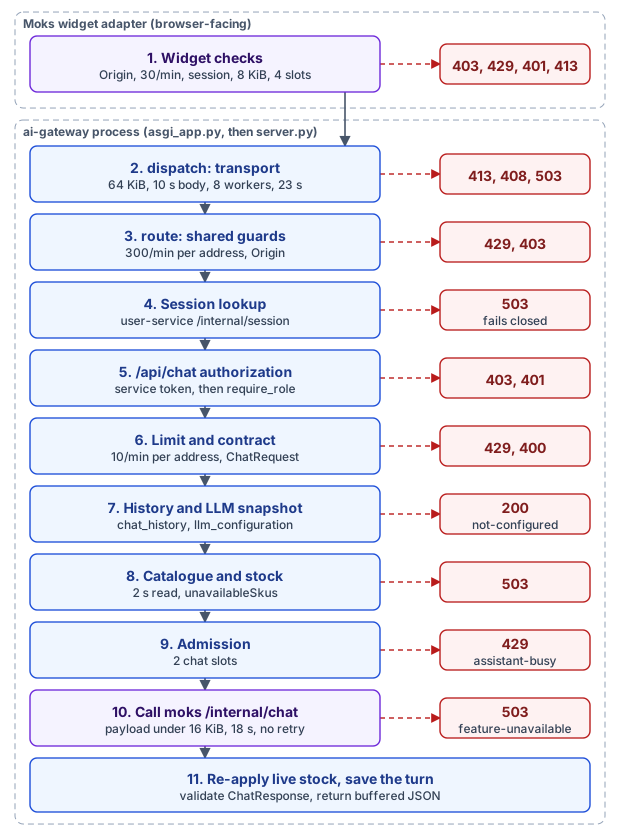
Figure 1. Every refusal happens before money is spent on a model call.
The order matters. Cheap checks come first, and the model call is the last thing that can go wrong. Here is the core of step 5 to step 9:
# services/ai-gateway/server.py
authenticate_service(req.headers)
user = require_role(req.user)
self.limit(req, True)
data = req.body()
message = text(validate(ChatRequest, data).message)
previous = self.chat_history.read(user["id"])
active = self.llm.current()
The service token proves the caller is the widget. require_role proves there is a signed-in person behind it. The widget forwards exactly one cookie, a validated rs_auth value, so no other browser state crosses this boundary.
Authentication and validation
The gateway treats sessions as opaque. UserClient.current posts the token to user-service and trusts the answer, with no local fallback.
Validation is layered, and each layer has a different job. ChatRequest uses extra='forbid' and strict=True, limiting message to 1,000 characters, so a request cannot smuggle a userId or a history field. On top of that, the Moks README's claim that "the browser can never supply history" holds up: the widget accepts an optional context field for compatibility and throws it away.
Responses are validated too, but only after authorization has run. A comment in asgi_app.py explains why: schemas should never be able to disclose an authentication decision. If ChatResponse.model_validate fails, the caller gets a 502 with a request ID.
Provider configuration: control without inference
"Model-provider integration" in this service means managing a small document in MongoDB. The super admin chooses a provider in Admin → AI / LLM configuration. Fresh installs start at provider: none, and no model is hard-coded.
LLMConfiguration stores one record, _id: "active", holding the config, a revision number and a bounded audit list. Saving uses a compare-and-set:
# services/ai-gateway/llm.py
result = self.collection.find_one_and_update(
    {"_id": "active", "revision": revision},
    update,
    upsert=revision == 0,
    return_document=ReturnDocument.AFTER,
)
validate_config is strict because this document decides where customer questions get sent. Bedrock accepts only provider, region and model. There is deliberately no field for credentials, since Bedrock uses the workload's AWS credential chain. Ollama accepts only an alias from the operator's OLLAMA_ENDPOINTS_JSON, and those entries must be literal IP addresses, which the code comment says prevents DNS rebinding and proxy bypasses. Automatic failover has only one valid shape, Ollama primary with Bedrock fallback, and saving it requires both providers to pass a live test first.
The revision does a second job. The gateway sends its config and revision to Moks with each chat. Before every provider attempt, Moks calls GET /internal/llm/config and refuses to proceed if anything changed. That is how Disconnect can stop further paid attempts while a request is already running.
Streaming: there isn't any
Chat is buffered JSON end to end. The README says so plainly: "No tokens are sent until generation completes." The Ollama adapter sends "stream": False, and the Bedrock adapter calls Converse, not ConverseStream.
This keeps several things simple. The gateway can validate a complete answer, filter its product cards against live stock, and save a finished turn. Only complete responses reach the customer. The price is perceived latency: a shopper watches a spinner for the full generation. A comment in the Istio VirtualService leaves room for streaming later, but no streaming code path exists today.
Timeouts, retries and overload
The time budgets nest, and each outer layer is longer than the one inside it. That means the inner layer gives up first and produces a meaningful error, instead of an outer proxy cutting the connection.
| Layer | Budget | Where |
|---|---|---|
| NGINX to Moks widget | 30 s read | routes.conf |
| Widget to gateway | 26 s | widget.py |
| Gateway request deadline | 23 s | asgi_app.py |
| Gateway to Moks engine | 18 s | server.py |
| Moks retrieval and inference | 16 s | moks/server.py |
| One provider attempt | 12 s, or 6 s with failover on | routing.py |
Retries are narrow on purpose. _retry_read in lib/runtime.py retries once, only for GET or HEAD, only on transient failures, and inside the original budget. The chat POST to Moks is never retried, because a retry could mean paying for a second generation. A comment in routing.py sets the same rule for providers: exactly one fallback, and errors propagate.
Concurrency is bounded at three levels. The gateway runs eight blocking handlers (slots), and a ninth request gets 503 Gateway busy. Chat gets two slots of its own (chat_slots). A code comment gives the reason: the agent calls back into the gateway for its revision check during a chat, so some HTTP workers must stay free. Moks adds two provider slots per process.
Admission and failure are distinct. A full chat queue returns 429 assistant-busy with Retry-After: 5. An unavailable provider returns 503 feature-unavailable. Clients and dashboards can tell "try again in a moment" from "something is broken".
A rate-limit problem worth knowing about
Gateway.limit keeps an in-memory counter per client address: 300 requests a minute generally, 10 for chat. The address comes from client_address:
# services/ai-gateway/client_address.py
if os.getenv("TRUST_PROXY") == "true" and any(
    address in net for net in trusted
):
    return str(ipaddress.ip_address(req.headers.get("x-real-ip", "")))
return str(address)
Reading this against the manifests turned up a gap. TRUST_PROXY is true, but TRUSTED_PROXY_CIDRS is not set anywhere in the repository or the deployment configuration, so trusted is empty and the function always returns the direct peer. For chat, that peer is the Moks pod. As written, the 10-per-minute chat limit is therefore shared by all shoppers on a Moks replica, not applied per shopper, and the 300-per-minute limit is shared by everyone behind web.
The counters are also per process, and a sidecar may change the peer address the application sees. I reached this by reading the code, so test it on a running cluster before relying on it. The widget's own limit of 30 attempts a minute is global per replica by design: its comment explains that it avoids spoofable forwarded headers and an unbounded per-IP map.
Logging, tracing and cost
log_event writes JSON and keeps only allowlisted fields, so message text cannot reach logs by accident. request_completed records route, status and duration. dependency_call_completed records each downstream call. When TELEMETRY_ID_KEY is set, user identifiers are written as HMAC hashes.
Tracing follows W3C Trace Context through every hop, and each response carries X-Request-ID equal to the trace ID. On EKS, OTEL_SDK_DISABLED=true currently turns export off, so the ID is useful for log search rather than a trace view.
Token usage and cost controls are thin at this layer, and it is better to be direct about what exists.
| Control | Status |
|---|---|
| Tokens recorded per generation | Yes, in Moks spans, when the provider reports them |
| Tokens recorded by the gateway | No |
| Output cap | Yes, 600 tokens, in Moks |
| Prompt cap | Yes, character budgets, in Moks |
| Rate limits | Yes, with the caveat above |
| Per-user or daily token budget | Not implemented |
| Spend alerting | Not implemented |
| Response caching | Not implemented |
Debugging with real signals
Each example below uses a real route or log event. The output in the first one was captured on 1 November 2026.
The widget returns 502 but the store is fine
$ curl -s -o /dev/null -w "%{http_code}\n" https://eks.jithendar.com/roboshop/moks/available
502
$ curl -s https://eks.jithendar.com/roboshop/api/status
{"assistantMode": "ai", "checkoutMode": "razorpay"}
$ curl -s https://eks.jithendar.com/roboshop/ready
{"status": "ready", "dependencies": {"mongodb": "ready", "catalogue": "ready", "users": "ready", "ledger": "ready", "cart": "ready"}}
The 502 comes from NGINX, not from the application. The confusing line is assistantMode: ai, which only means an LLM configuration is saved in MongoDB. /api/status reads that record and does not contact Moks, and /ready deliberately ignores AI. Check the workload itself:
kubectl --context roboshop-demo -n roboshop-ai get deploy moksThat command is read-only. A NotFound result means the workload is not deployed, which was the actual cause here.
The assistant says it is busy
Two different 429s reach the widget, and the JSON tells them apart.
| Body | Cause | First step |
|---|---|---|
code: assistant-busy | Both chat_slots are in use | Look for slow provider calls |
Too many requests. Please wait a minute. | Address limit, or the widget's 30-a-minute limit | Remember the limit may be shared by all users |
Chat fails with 503 feature-unavailable
The gateway hides the reason from the customer, so read the Moks logs:
kubectl -n roboshop-ai logs deploy/moks | grep -E 'llm_attempt_failed|llm_failover_selected'errorCode will be one of the values in ProviderError: access-denied usually means a missing IAM permission, invalid-model a wrong or incompatible model ID, throttled a provider limit or the two-call cap. unavailable with no attempt logged usually means the revision guard refused the call, which happens if settings changed or Moks could not reach /internal/llm/config.
Every answer says "Please connect an LLM to get results."
That is unconfigured(), returned with HTTP 200 when the active provider is none. It is a normal state, not an error, and the fix is in the admin console. The widget turns it into a 503 with code: ai-not-configured, so browser dev tools and the gateway logs will appear to disagree.
Limitations
- The ledger forces one replica. The default JSON store allows a single writer.
- Rate limits are per process. Replicas would not share counters, and the address problem above still applies.
- A failed history save loses the answer.
ChatHistory.saveruns after generation. If MongoDB fails at that moment the customer gets a 503 for a reply that was already paid for. - The name is misleading. Anyone expecting a model proxy should read
llm.pyfirst.
Frequently asked questions
Should every AI application have a gateway like this?
Not necessarily. If your application already has an authenticated API layer, the useful idea is to put admission, identity and provider policy there. You rarely need a new service to do it.
Why not put the model call in the gateway?
The code keeps provider credentials, retries and slow calls out of the process that owns payments. The next article in this series covers how external clients reach the same gateway through MCP.
Discussion comments
No comments yet. Start the discussion.