Inside RoboShop AI: microservices on Kubernetes, from Minikube today to an EKS-ready design
How RoboShop AI's storefront, gateway, AI assistant and data services fit together, how it ships to Kubernetes today, and how its EKS stack is designed.
Published 10 min read

On this page
RoboShop AI is a robot store built from independently deployable services: a TypeScript storefront, a Python API gateway, a LangGraph shopping assistant, Go and Java services, and MongoDB, PostgreSQL, Redis, RabbitMQ and Kafka behind them. It runs live at jithendar.com/roboshop, and the code is public on GitHub.
This article walks through how it works, how it is deployed today, and how its Amazon EKS stack is designed.
At a glance
- One public entry point. Only the edge proxy and gateway receive browser traffic; every other service is internal.
- Polyglot by design. TypeScript, Python, Go and Java services, each with its own Dockerfile and Kubernetes manifest.
- AI that cannot act on its own. The shopping assistant's model output is guidance only; it cannot execute tools, and no model is connected until an administrator chooses one.
- Events without coupling. Orders flow to shipping over RabbitMQ; Kafka receives a replayable copy for analytics without adding a dependency to checkout.
- Observable end to end. OpenTelemetry traces, Prometheus metrics and Loki logs across the services.
What RoboShop AI looks like
The storefront is a catalogue of twenty robots with search, filters, product pages, a cart and checkout.
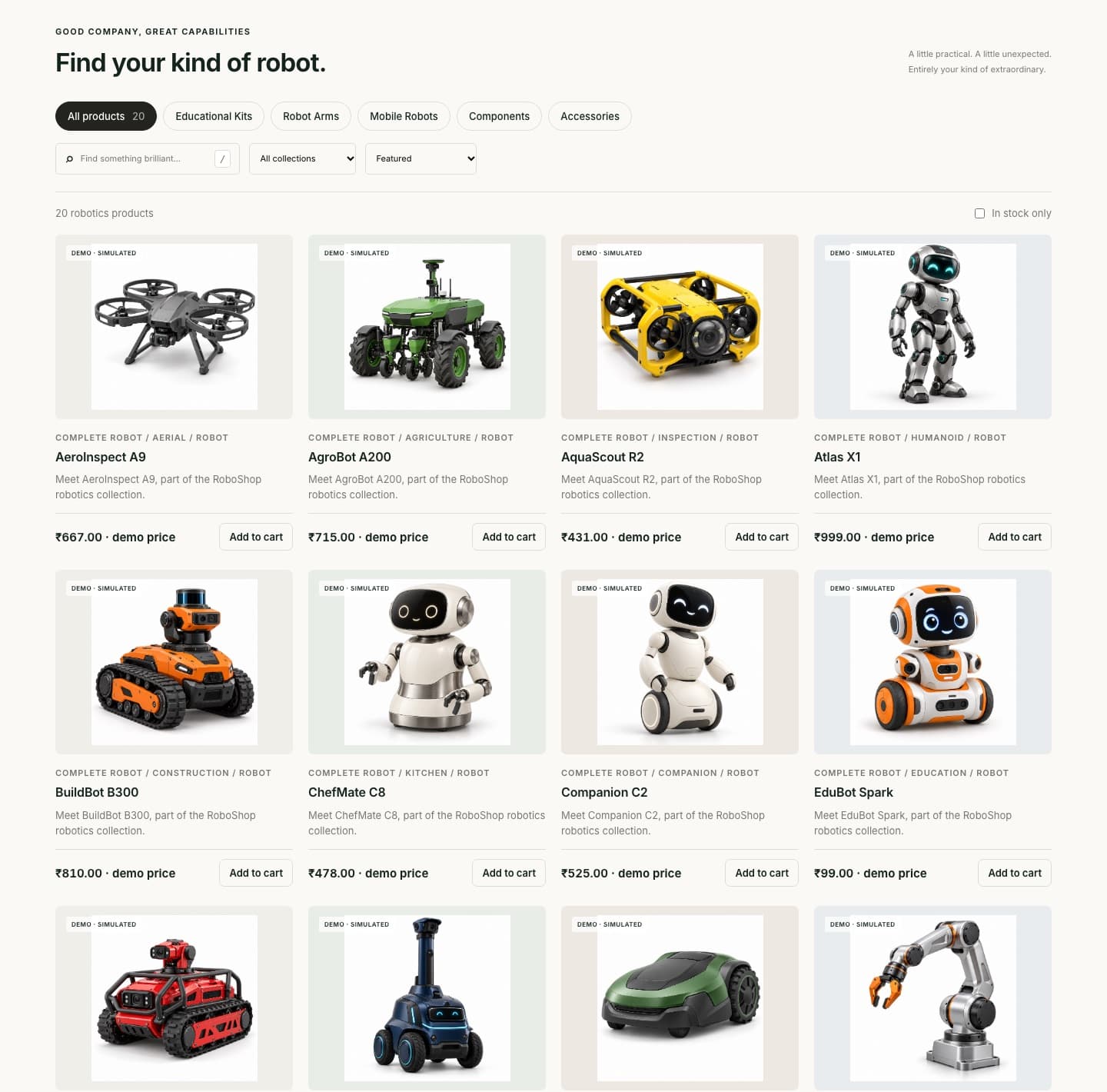
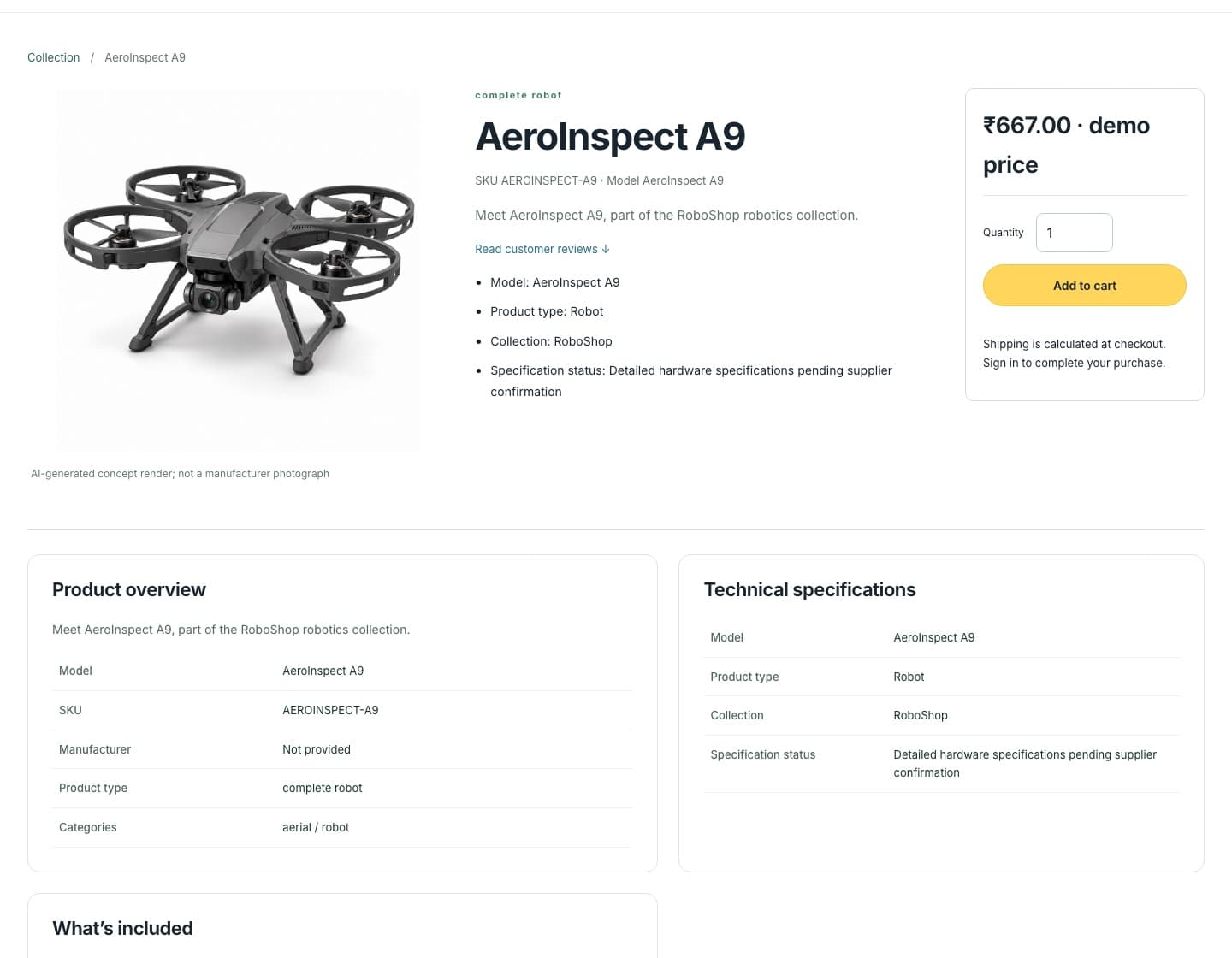
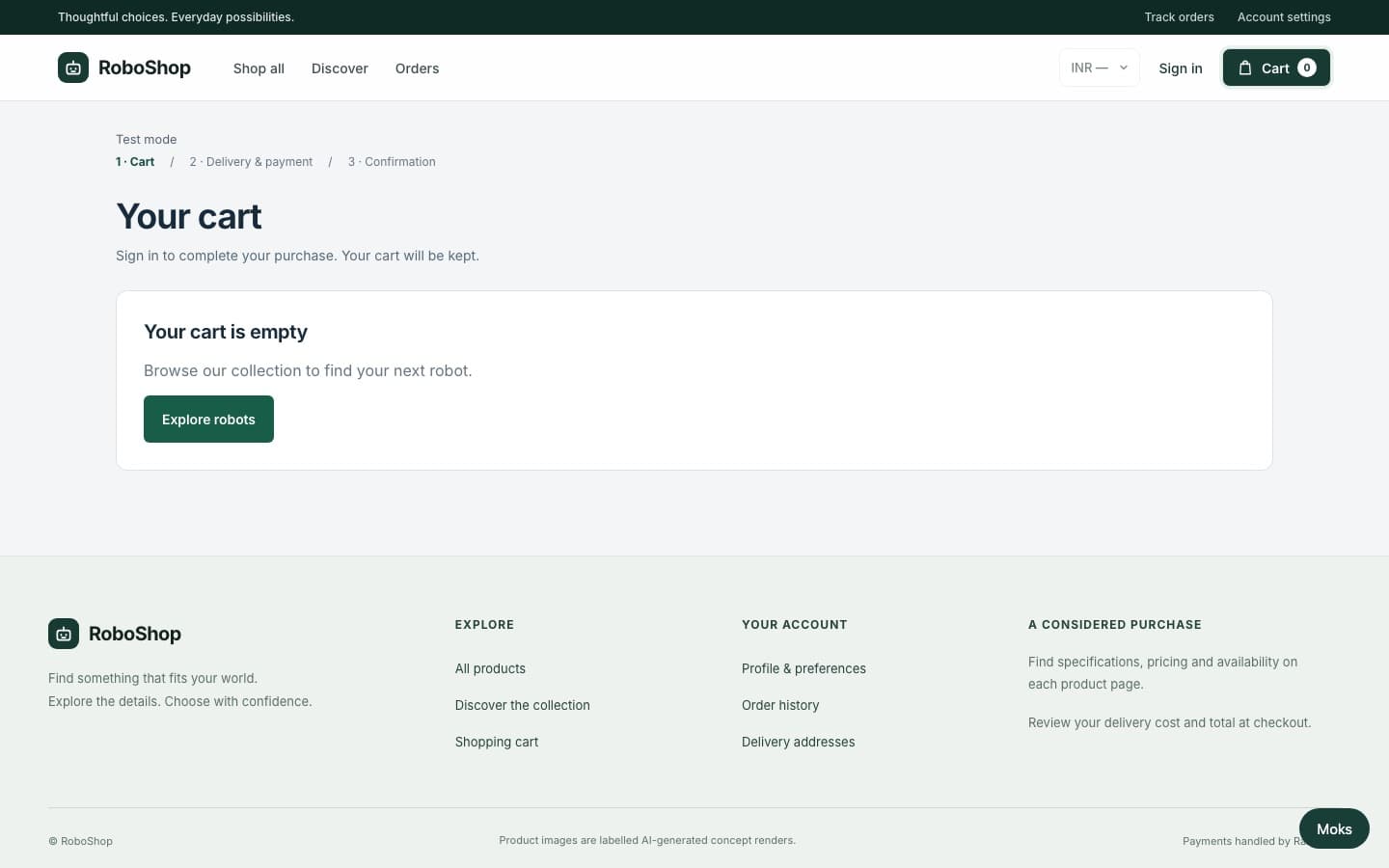
Architecture overview
The browser talks to one origin. The edge proxy serves the storefront and forwards API calls to the AI gateway, which routes to the internal services.
Browser ──► nginx (edge) ──► frontend (storefront assets)
                │
                └──► ai-gateway :3000 ── public API, auth, order ledger
                        ├──► catalogue-service :4108 ──► MongoDB (products)
                        ├──► user-service ─────────────► MongoDB (accounts, sessions)
                        ├──► cart-service ─────────────► Redis
                        ├──► payment-service :4105 ────► Razorpay Orders & Payments API
                        ├──► moks (shopping agent) :4103 ──► LLM selected by a super admin
                        ├──► currency-service ─────────► ECB reference rates (hourly, cached)
                        └──► outbox ──► RabbitMQ ──► shipping-service ──► PostgreSQL
                                          └──► kafka-bridge ──► Kafka (analytics events)

mcp-server (internal) ──► gateway tools OpenTelemetry ──► collector ──► JaegerTwo rules shape everything else:
- Only the gateway is exposed for application traffic. Requests are same-origin, so the browser never talks to a backend directly.
- Each service owns its data. The catalogue owns product reads, the user service owns accounts, the cart service owns Redis, the gateway owns the order ledger, and shipping owns its PostgreSQL database.
The services
| Service | Stack | Responsibility |
|---|---|---|
frontend | TypeScript | Storefront, product pages, cart and admin UI |
nginx | nginx | Edge proxy, asset routing and security headers |
ai-gateway | Python | Public API routing, authorization and the order ledger |
user-service | Python + MongoDB | Accounts, sessions, profiles, MFA, email recovery and purchase history |
catalogue-service | Node.js + MongoDB | Catalogue reads, validated imports and publication |
cart-service | Python + Redis | Carts |
payment-service | Node.js + Razorpay | Payment orders and captured-payment verification |
shipping-service | Java/Gradle + PostgreSQL | Locations, quotes and shipment requests |
currency-service | Go (standard library) | Estimated local-currency prices from the ECB reference feed |
moks | Python, LangGraph/LangChain | The shopping assistant (widget and AI engine) |
mcp-server | Python, FastMCP | Diagnostics and Model Context Protocol tools, internal only |
kafka-bridge | — | Copies order events from RabbitMQ to Kafka |
Supporting infrastructure: MongoDB, PostgreSQL, Redis, RabbitMQ and Kafka, plus Prometheus, Grafana, Loki/Alloy, the OpenTelemetry Collector and Jaeger.
How a purchase flows through the system
1. Browsing and search
The catalogue service reads products from MongoDB. Recommendations and the assistant's retrieval work from that same catalogue snapshot, and the gateway supplies the sold-out exclusions so nobody is recommended something they cannot buy.
2. Prices in your currency
currency-service downloads the European Central Bank's reference feed once an hour, with a five-second deadline and a 64 KiB response limit. Requests only ever read the cache, so a slow upstream can never slow the storefront. After two hours without a successful refresh, rates are labelled stale; after seven days they are withdrawn rather than guessed. The rates are informational: country is a display hint and cannot affect payment.
3. Cart and checkout
Carts live in Redis behind cart-service. Orders, stock reservations and payment orders are recorded in the gateway's commerce ledger, which has a single writer so stock can never be double-counted. Today that ledger is a JSON store on one gateway replica; a transactional PostgreSQL ledger is built and tested as an opt-in migration (COMMERCE_BACKEND=postgres) but not yet switched on.
Checkout uses stock reservations: stock is held for the order before payment, so two buyers cannot both pay for the last unit.
4. Payment
payment-service integrates Razorpay's Orders and Payments API. The design does not trust the browser's word that a payment succeeded:
- payment signatures are validated on the server,
- the payment is checked as captured before the order is confirmed,
- signed webhooks and status recovery reconcile anything the browser never reported back.
5. Shipping and analytics events
Confirmed orders are written to a durable outbox and published to RabbitMQ with publisher confirms, which feeds shipping-service. Separately, an independent quorum queue feeds kafka-bridge, which publishes to Kafka and only acknowledges RabbitMQ after Kafka confirms delivery. The result is a replayable event stream for analytics, with no Kafka calls or readiness dependencies added to checkout.
The AI shopping assistant
The Moks button on every page opens the shopping assistant: one Python process serving both the widget and a LangGraph/LangChain engine.
- Who chooses the model. Only a super admin can connect a provider (Amazon Bedrock Converse or an approved Ollama endpoint), test it, and activate it. Configuration changes are revisioned and audited.
- No database access for the agent. The agent owns inference but has no MongoDB credentials. Before every generation it reads the active configuration from the gateway; a changed revision or a disconnect stops new attempts.
- Guidance, not actions. Model output cannot execute tools.
The MCP server exposes 15 tools with strict schemas and mutation annotations through FastMCP. Every call goes through the gateway, it is reachable only on the internal Kubernetes Service, and it has no public ingress.
Security and hardening
- Containers run non-root, with a read-only root filesystem and dropped Linux capabilities.
- Secrets are never baked into images; they are provided at runtime.
- The gateway checks Origin and CSRF protections on authenticated actions.
- There is no default administrator password. Customers, admins and a single super admin have separate roles.
- Payment safety relies on server-side signature and capture checks, not the client.
Observability
Every service exposes liveness and metrics endpoints. The gateway's readiness check includes its dependencies, so Kubernetes stops sending traffic to it when something it relies on is down.
| Signal | Path |
|---|---|
| Traces | Services → OpenTelemetry Collector → Jaeger (context propagates across internal HTTP calls) |
| Metrics | Prometheus scrapes each service; dashboards in Grafana |
| Logs | Loki, collected with Alloy |
| LLM traces | Optional Langfuse endpoint for the assistant |
How it is deployed today
git push ──► GitHub Actions (self-hosted ARM64 runner)
               └─ docker build (linux/arm64) ──► Amazon ECR  roboshop-<service>:latest
                                                     │
Argo CD catalog (manual sync) ──► Minikube cluster ◄─┘  pulls with an ecr-pull secret
└─ Traefik /roboshop ─► strip prefix ─► nginx ─► services- Cluster. A four-node Minikube cluster (arm64 nodes) on a single server, shared with other workloads.
- Images. Each service has its own GitHub Actions workflow that builds an
arm64image on a self-hosted runner and pushes it to a private ECR repository. - Delivery. An Argo CD catalog describes every workload. New applications start with manual sync and no automatic pruning, so each change is reviewed in Argo CD before it reaches the cluster.
- Registry credentials. ECR tokens expire, so a CronJob refreshes the
ecr-pullimage-pull secret every six hours. - Routing. Traefik serves the app under
/roboshopand strips that prefix before forwarding to the edge proxy. TLS comes from cert-manager and Let's Encrypt.
The EKS design
The infrastructure/ Terraform describes how RoboShop AI would run on Amazon EKS. It is opt-in: nothing changes unless eks_enabled = true is supplied, and today the file is parked as eks.tfbk.
Network
| Layer | CIDRs (first two AZs) | Purpose |
|---|---|---|
| Private | 10.0.0.0/20, 10.0.16.0/20 | EKS nodes, pod addresses and control-plane network interfaces |
| Public | 10.0.240.0/24, 10.0.241.0/24 | Internet-facing load balancers and NAT gateways |
- Private subnets reach the internet through a NAT gateway in the same AZ (a single shared NAT is an optional cost saving with a resilience trade-off).
- An S3 gateway endpoint carries S3 traffic, including ECR image layers, without NAT.
- Neither subnet type assigns public IPs to instances automatically.
Cluster
- Kubernetes 1.36, deliberately chosen over the newer 1.37 to stay inside cert-manager 1.21's tested range.
- API access is locked down: the private endpoint is always on; the public endpoint is enabled only for listed admin/CI CIDRs, and
0.0.0.0/0is rejected by validation. - Access entries (authentication mode
API) grant cluster-admin only to listed IAM roles or users. No cluster creator gets implicit admin access. - Control-plane audit, API and authenticator logs go to CloudWatch.
- A managed node group of two
t3.largeon-demand workers (configurable from 2 to 6) runs in the private subnets on Amazon Linux 2023. - Core add-ons:
vpc-cni,coredns,kube-proxyandeks-pod-identity-agent, versions resolved against the selected Kubernetes version.
Add-ons (designed, later removed from the repository)
A second Terraform state installed the platform layer once the cluster existed:
| Component | Version | Role |
|---|---|---|
| Traefik | chart 42.1.0 | Ingress and TLS termination |
| AWS Load Balancer Controller | chart 3.6.0 | Provisions Traefik's public NLB, using pod identity |
| EBS CSI driver | — | Encrypted gp3 storage class (WaitForFirstConsumer, Retain), using pod identity |
| cert-manager | v1.21.2 | Let's Encrypt staging and production issuers (HTTP-01 through Traefik) |
| KEDA | 2.21.0 | Event-driven autoscaling |
The whole stack is applied by a manual Create infrastructure GitHub Actions workflow on the self-hosted runner: format check, validate, test, then plan and apply in order. There is no plan-only option, so every run applies.
Minikube today versus the EKS design
| Concern | Minikube (today) | EKS (design) |
|---|---|---|
| Nodes | 4 × arm64, single server | 2–6 × t3.large (x86_64), private subnets, multiple AZs |
| Ingress | Traefik on the host | Traefik behind an AWS NLB |
| Storage | standard host-path volumes tied to one node | Encrypted gp3 EBS volumes |
| Delivery | Argo CD catalog, manual sync | New cluster; application delivery not yet defined |
| Cost | One server | EKS control plane, EC2, NAT, load balancer, logs and volumes |
What I would do next
Explore the code
- Live app: jithendar.com/roboshop
- Source: github.com/mrjithendar/roboshop-ai
- How this publication itself is deployed: Deploying a Next.js site to Kubernetes
Related reading
- Kubernetes & Cloud NativeProject
RoboShop AI: a microservices storefront with an AI shopping assistant
A polyglot microservices store - TypeScript, Python, Java - with an AI shopping assistant, MCP tools and full observability, deployed with Argo CD.
1 min read
Comments
No comments yet. Start the conversation.