The admin of jithendar.com has a page at /admin/lancedb. It shows one table, 3,179 rows, and a location that starts with s3://. This post explains what that data is, why it lives in LanceDB on Cloudflare R2 rather than only in PostgreSQL, how the page can edit it without doing damage, and what I found when I checked it against the live system on 24 November 2026.
The short version:
- LanceDB holds one table,
article_chunks. It's a copy of the pgvector index that Ask the Blog searches, with the same vectors, so nothing is embedded twice. - Nothing searches the copy yet. Ask the Blog and the crews still read pgvector. CrewAI memory, the other half of what the page's description promises, hasn't been built.
- LanceDB has no server, so only the seo-agent opens it. The admin page goes through the agent's API, changes one row at a time, and can't touch vectors.
- It cost 105 MiB of image size.
- In its first week the copy drifted. It still holds 32 chunks of a deleted article, and neither store has the two articles I published by hand on 23 November.
- A vector query against the copy on R2 took about 0.7 seconds. pgvector answers the same query in about 3.5 ms.
What the page shows
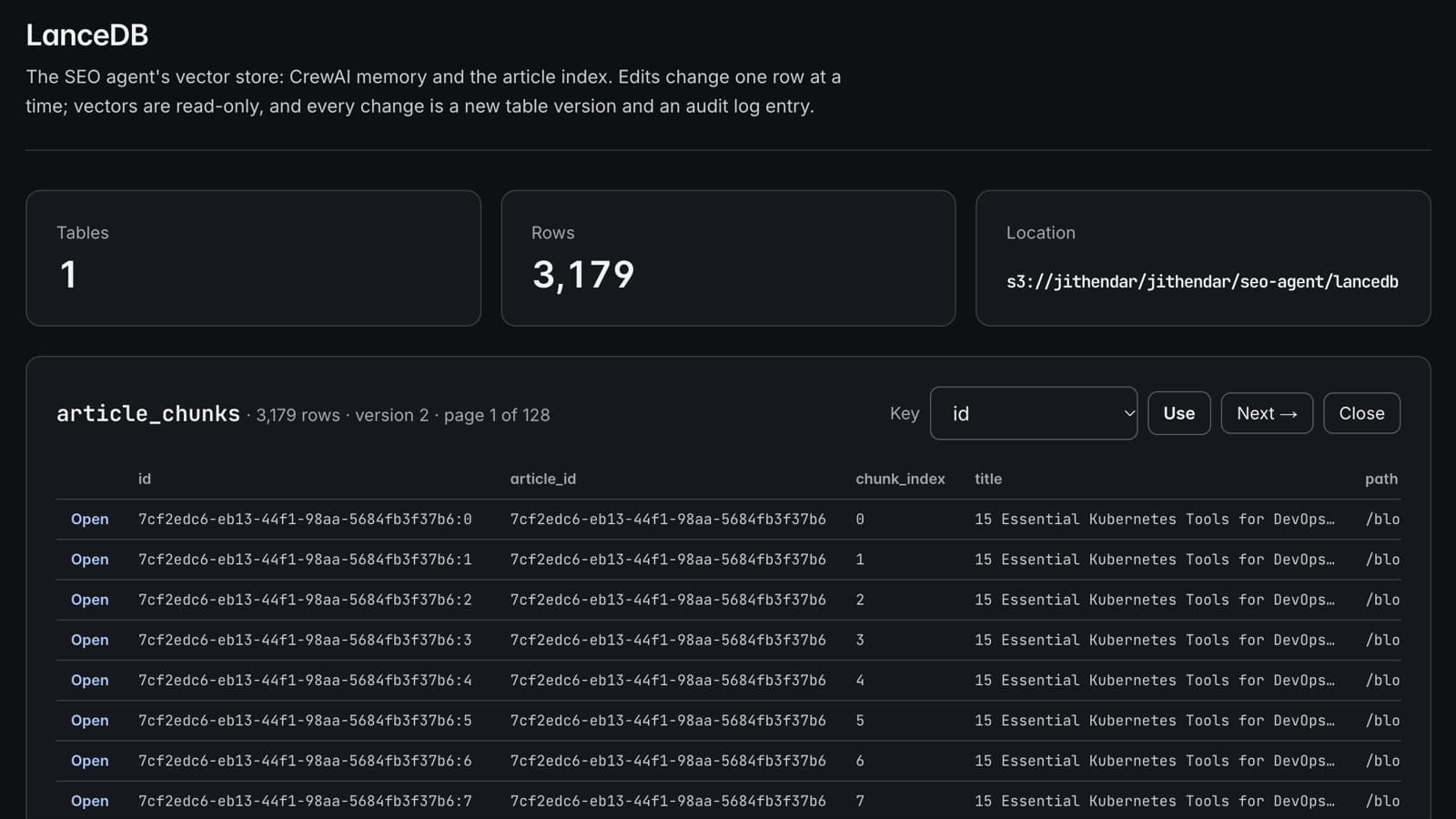
From top to bottom:
- Tables and Rows add up every table the agent can see. There is one.
- Location is the LanceDB URI: the media bucket, then the prefix
jithendar/seo-agent/lancedb. The agent strips any credentials from the URI before sending it, and the keys themselves are never part of it. article_chunks · 3,179 rows · version 2 · page 1 of 128: LanceDB numbers every write as a new table version, and the page reads 25 rows at a time (3,179 ÷ 25, rounded up, is 128).- Key picks the column used to find a single row. The page offers
idwhen the table has one, andOpenloads that row in full, with forms to edit or delete it.
The columns are those of the article index in Postgres, plus the vector:
| Column | What it holds |
|---|---|
id | <article_id>:<chunk_index>, unique, so it works as the key |
article_id, chunk_index | which article, and the chunk's position in it |
title, path, category | the article as readers see it |
heading_path, anchor | the section the chunk sits in, and its link anchor |
content, content_hash | the chunk's text (about 700 characters on average) and its hash |
model | the embedding model: onnx:bge-small-en-v1.5 for every row today |
updated_at | when Postgres last wrote the chunk |
vector | fixed_size_list<float>[384], the embedding, shown cut short and read-only |
One thing on the page is ahead of the code. The description says "CrewAI memory and the article index", but only the article index exists. The memory half is still a plan (see Where it stands).
Why LanceDB came back
CrewAI lists LanceDB as a dependency because its memory feature stores records there. When I built the flows and crews (opens in a new tab) behind this site, nothing used memory, so I removed LanceDB with a uv override that never matches any platform (lancedb; sys_platform == 'never'), and a test checked it stayed out. That kept about 290 MB out of the virtual environment.
On 17 November I reversed that. I wanted the agent's vector data on R2 and manageable from the admin, so that I can see, edit and delete it. When asked what LanceDB should hold, I chose two things: CrewAI's memory and the article index. That broke two earlier rules on purpose: "LanceDB is not installed" and "one database: PostgreSQL holds the vectors".
The cost was measured when the change was made, and pyproject.toml still says so:
# pyproject.toml (moks-seo-agent, excerpt)
# LanceDB (+ pyarrow, +105 MiB of image as stored) is installed since D-91 (owner decision 2026-11-17): CrewAI's memory and the article
# index are to be stored in LanceDB on Cloudflare R2. Until D-91 it was overridden away (D-47), because nothing used it.
The image went from 363.8 to 468.9 MiB as stored (+28.9%), with lancedb 0.40.0 and pyarrow 26.0.0. Installing it changed no behaviour: crews are still built with memory=False, and flows still skip CrewAI's automatic memory.
The work then landed in three steps, each its own pull request (the agent still lived in the moks-cms repository then):
| Date (2026) | Change | What it did |
|---|---|---|
| 17 Nov | D-91, moks-cms #121 | Installed lancedb and pyarrow. Nothing used them yet. |
| 18 Nov | D-92, moks-cms #122 | Connected to R2 using the keys from Admin → Storage, and added /admin/lancedb. No tables yet. |
| 18 Nov | D-93, moks-cms #124 | Copied the article index into the table article_chunks after each reindex. |
No server, so one writer
LanceDB's documentation describes the open-source version as "an open-source, embedded retrieval library": "the library runs inside your process. There is no server to deploy, configure, or keep available." On this site, the "database" is a folder of Lance files under an R2 prefix, plus whichever process has the library loaded.
That gave the design its main rule: only the seo-agent opens LanceDB. The agent runs as one replica with the Recreate strategy, so even a rollout never has two pods writing at once. The web app never connects to R2 for LanceDB. The admin page calls the agent's internal API on its ClusterIP port, with the bearer token SEO_AGENT_TOKEN.

The documentation gives three reasons a single writer matters:
- Writes use optimistic concurrency. A writer checks its change against commits made in the meantime, and "conflicts may be retried or returned as errors. Applications must handle failed writes."
- Cleaning up old versions should only happen "when you can guarantee no other process is writing to the table", and the copy cleans up after every write (more on that below).
- "By default, an Embedded table handle does not automatically pick up another process's writes."
With one writer, none of these come up. The cost is that the agent becomes the only way in, for the admin page too.
Where the keys come from
There are no LanceDB-specific secrets. The media bucket's settings live in Admin → Storage, and the agent asks the web app for them over the internal port the first time it needs LanceDB:
# app/lance_admin.py (excerpt)
async def ensure(self) -> None:
    """Connect to the storage Admin → Storage describes, once it exists (checked again at most once a minute)."""
    if self.uri or self.resolve is None or time.monotonic() - self._asked_at < RETRY_S:
        return
    self._asked_at = time.monotonic()
    try:
        cfg = await self.resolve()
    except Exception as e:  # the web app is down or refuses: stay unconfigured, say why in the log
        log.warning("lancedb storage unavailable", extra={"event": "lancedb_storage_unavailable", "error": type(e).__name__})
        return
    if not cfg.get("configured") or not str(cfg.get("uri", "")).startswith("s3://"):
        return
    self.uri = str(cfg["uri"])
    opts = {"endpoint": cfg.get("endpoint"), "aws_access_key_id": cfg.get("accessKeyId"), "aws_secret_access_key": cfg.get("secretAccessKey"), "region": cfg.get("region") or "auto"}
    self.storage_options = {k: str(v) for k, v in opts.items() if v}
The web app answers with s3://<media bucket>/jithendar/seo-agent/lancedb, the endpoint, the keys and the region, or with {configured: false} until storage is set up. LanceDB's storage docs say S3-compatible stores "also need endpoint and region". For R2 that means the account's R2 endpoint and the region auto. For Amazon S3 without a custom endpoint, the web app sends an empty endpoint and the client finds AWS from the region. On a laptop, LANCEDB_URI points the agent at a local folder instead.
This has a trade-off I accepted when I chose it: the agent now holds the media bucket's keys, not keys limited to its own prefix.
The table: a copy of pgvector, rewritten whole
PostgreSQL with pgvector stays the source of truth. After each reindex that changed something, the agent copies the published articles' chunks into LanceDB, along with the vectors Postgres already holds:
# app/lance_index.py (excerpt)
SELECT = f"""select ch.article_id::text || ':' || ch.chunk_index as id, ch.article_id::text as article_id, ch.chunk_index,
       p.title, '/' || p.collection || '/' || p.slug as path, coalesce(p.category, '') as category, ch.heading_path,
       coalesce(ch.anchor, '') as anchor, ch.content, ch.content_hash, ch.model, ch.updated_at, ch.embedding::text as embedding
     from {LIVE_TABLE} ch join post p on p.id = ch.article_id
     where p.status = 'published' and p.deleted_at is null
     order by p.title, ch.article_id, ch.chunk_index"""
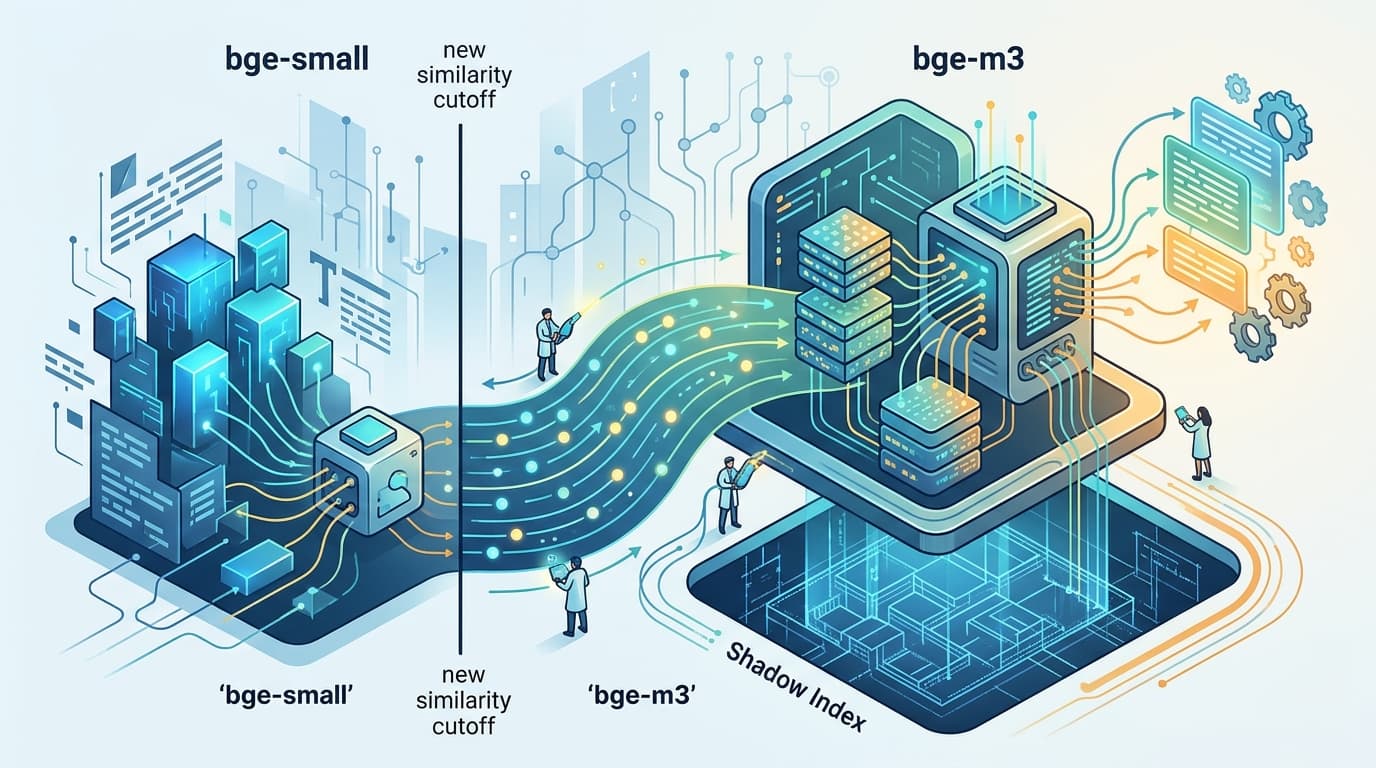
The rows become an Arrow table with a fixed-size float32 vector column, which is what LanceDB searches. If the chunks have vectors of different sizes, the build fails rather than writing a half-converted table. That matters for the planned switch from bge-small to bge-m3 (opens in a new tab), where the size goes from 384 to 1,024.
Then the whole table is written as one new version, and older versions are removed:
# app/lance_index.py (excerpt)
KEEP_VERSIONS = dt.timedelta(hours=1)  # a browser page still reading the previous version keeps working

t = db.create_table(TABLE, data=to_arrow(rows), mode="overwrite")
try:
    t.optimize(cleanup_older_than=KEEP_VERSIONS)
except Exception as e:  # cleanup is housekeeping: the new version is written either way
    log.warning("lancedb article index: cleanup failed", extra={"event": "lancedb_index_cleanup_failed", "error": type(e).__name__})
Rewriting the whole table means each sync leaves an exact copy of Postgres at that moment, with no row-by-row bookkeeping; at about 3,000 rows a full rewrite is cheap. Called without an argument, optimize() removes versions older than 7 days. Here one hour is enough for a page that is still reading the previous version, so R2 holds about one copy of the index.
Three guards keep the copy from doing harm:
- An empty result never replaces a filled table. A broken query keeps the previous copy instead of wiping it.
- A failed sync never fails the reindex. It's logged as a warning (
lancedb_index_failed) and the reindex result recordslancedb_synced: 0. - The switch
LANCEDB_ARTICLE_INDEX("Copy the article index into LanceDB" in the Retrieval settings, applied on restart) turns the copy off. It's on by default because it changes nothing anyone reads.
What it looked like on 24 November
A read-only check from inside the agent pod:
rows 3179  version 2
version 2 written 2026-11-22 03:23:17 UTC
stats: total_bytes 6615593, num_fragments 1, num_indices 0
articles 68, model onnx:bge-small-en-v1.5 (all rows)
Version 2 was written by the weekly reindex on Sunday 22 November, which embedded 671 chunks, left 2,508 unchanged, and reported lancedb_synced: 1. Version 1, the first copy, was removed by cleanup as designed. The whole index is one 6.6 MB data file with no vector index. LanceDB's docs say an index is "usually unnecessary overhead" for "datasets around 100K rows or fewer", and this table is about 3% of that.
How the copy drifted
The copy is rewritten only when a reindex changes something. On 24 November, the two stores disagreed:
| Chunks | Articles | |
|---|---|---|
| pgvector (published) | 3,147 | 67 |
LanceDB article_chunks | 3,179 | 68 |

There are two gaps, and only one of them is in the copy.
Deleting an article doesn't touch the copy. One article was deleted after the 22 November sync. Its 32 chunks left pgvector together with the post, but that path runs no reindex, so the sync was never triggered. The copy still holds them, and /admin/lancedb still shows them. No reader sees this today, because nothing searches the copy. If LanceDB ever answered Ask the Blog questions, it could cite an article that no longer exists.
Publishing by hand doesn't index the article. The reindex schedule's description says "publishing also reindexes each article". That's true for publish_flow, which publishes approved AI drafts. It isn't true for Publish in Admin → Posts, which is how every article pushed from the jithendar.com repository goes live. The two articles I published that way on 23 November (the PyTorch reranker (opens in a new tab) and the home page 520 postmortem (opens in a new tab)) have no chunks in pgvector, so Ask the Blog can't find them today. They'll get chunks at the next weekly reindex, on Sunday 29 November at 03 UTC. A manual run of reindex_flow would add them sooner.
The second gap isn't about LanceDB at all, but the copy is how I found it. Both gaps need a decision from me rather than a quick patch, so they're listed as open below.
Editing one row safely
The browser is generic: it lists whatever tables exist and can edit any of them. It was built for CrewAI memory, where deleting a wrong memory record is a real need. That made the limits important.

LanceDB's update and delete take the row filter as a SQL string, so there are no bound parameters. Every value that ends up in a filter goes through one function, which knows the column's type:
# app/lance_admin.py (excerpt)
def _literal(value: Any, kind: str) -> str:
    """A value as a SQL literal for LanceDB's filter language (DataFusion). Never interpolates anything else."""
    ...
    if kind == "string":
        s = str(value)
        if "\x00" in s:
            raise LanceError("text may not contain NUL")
        return "'" + s.replace("'", "''") + "'"
    raise LanceError("this column cannot be used here")
Table and column names never reach the filter as free text. They must match ^[A-Za-z_][A-Za-z0-9_]{0,127}$ and exist in the table's schema. Tests cover quotes and injection attempts.
Before anything changes, the filter has to match exactly one row:
# app/lance_admin.py (excerpt)
def _one(self, t: Any, where: str) -> None:
    n = t.count_rows(where)
    if n != 1:
        raise LanceError("row not found" if n == 0 else f"the key matches {n} rows; pick a unique key column", 404 if n == 0 else 409)
So a request can never change or delete many rows. If you pick a key column like title, which repeats across an article's chunks, the agent answers 409 and changes nothing.
Vectors are read-only, because a hand-edited embedding is never right. The page shows the first eight values, then … and the size, (384 dims). Nothing can create or drop a table from the browser.
Every write is a new table version, an info line in the agent's log with the admin's name, and an audit log entry in the web app (lancedb.update, or lancedb.delete at warning). The previous version stays in R2 until the next sync cleans it up, so a bad edit could be rolled back from Python, but the page has no button for that.
For article_chunks, an edit lasts only until the next sync, which rewrites the table from Postgres. The page and the user guide both say so. To change what the index says, edit the article. For now the browser is mostly a window on the copy. Editing will matter once memory records exist.
What a query costs on R2
D-91 noted that every read goes to R2, which is slower than local disk. I measured it from the agent pod (worker3) with six vectors taken from the table, against the same six-nearest-chunks query in pgvector:
| Store | How | Time per query |
|---|---|---|
| LanceDB on R2 | brute-force cosine, top 6, no index | 1,388 ms cold; then 734, 638, 619, 1,242 and 4,671 ms (median about 0.7 s) |
| pgvector (in the cluster) | embedding <=> $1, top 6, HNSW index | 2.9 to 11.2 ms (median 3.5 ms) |
In a fresh Python process, importing LanceDB, connecting and opening the table took another 3 seconds; the running agent pays that once. Loading the last page of the browser (offset 3,150) took about 1 second.
This isn't a fair fight. pgvector uses an approximate HNSW index on a database in the same cluster, while LanceDB scans every vector, with no local copy, from object storage in another network. The scan itself is small: 3,179 × 384 float32 values is about 4.9 MB, so most of the time is probably the trips to R2, though I didn't break it down. But it's the number that matters for the plan: as built today, a LanceDB retriever would add most of a second to every Ask the Blog question, on top of the model's own time.
Where it stands
| Step | What | State on 24 Nov |
|---|---|---|
| Install | lancedb and pyarrow in the image | Done (17 Nov) |
| Storage and browser | R2 keys from Admin → Storage, /admin/lancedb | Done (18 Nov) |
| Copy | article_chunks rewritten after a reindex that changed something | Live; drifts until the next such reindex |
| Retriever | a LanceDB Retriever next to PgVectorIndex, with the RAG evaluation (opens in a new tab) run on both | Not built |
| Cut-over | Ask the Blog on LanceDB, pgvector kept until the evaluation shows equal quality | Not built |
| CrewAI memory | memory on LanceDB, off by default, a switch per crew, each record showing where it came from | Not built |
Open items:
- Deleting an article. Rewrite the copy (or delete the article's rows) when an article is deleted or unpublished, not only after a reindex.
- Publishing by hand. Reindex the article when it's published from Admin → Posts, as
publish_flowalready does. - A match check. Compare row and article counts between the two stores after each reindex, and show both on the page, so drift is visible without running a script.
- Latency. Before building the retriever, decide whether 0.7 s per query on R2 is acceptable, or whether the agent needs a local copy of the table.
The copy has done its first job: the real index is in LanceDB, the same vectors as pgvector, and I can browse it from the admin. Whether it ever answers questions depends on the evaluation and on that 0.7 seconds.


Discussion comments
No comments yet. Start the discussion.