We had three services that each wanted retrieval-augmented generation, and we were on our way to building it three times. moks-sre-agent keeps runbooks and post-mortems in its own Postgres with pgvector, plus its own embedder and reranker pods. moks-seo-agent keeps jithendar.com's articles in a second pgvector store, with its own embedding settings and calibration. moks-cms needed its published articles searchable too, and kept in step with publish and unpublish. That's three chunkers, three embedding paths, three indexes to keep fresh and three sets of quirks to debug.
So we built one platform instead: a rag namespace on our Hetzner k3s cluster with one vector store (Qdrant), one embedding model (bge-m3), one document parser (docling-serve), one model gateway (LiteLLM, in front of Anthropic's Claude), one API (rag-api) and one chat UI (Open WebUI). Each service gets its own collection.
This post is how it's built and deployed, with the trade-offs. It also says plainly where we are: on 26 November 2026 the platform is live and healthy, but no service is connected to it yet and every collection is empty. Some of what follows is design, and I say which parts.
The constraint: CPUs only
The cluster is called mk4. It's k3s on four Hetzner ARM64 machines: a cax11 control plane (2 vCPU, 4 GB) and three cax21 workers (4 vCPU, 8 GB each). There's no GPU, and the workers already carry the site, MOKS, monitoring and a database.
That decides the shape. We call it Path A:
- Retrieval runs in the cluster. Parsing, chunking, embedding and vector search all work on CPUs. bge-m3 at 567M parameters is the heaviest piece, and it fits.
- Generation leaves the cluster. Answers come from Claude (
claude-sonnet-5-5, withclaude-haiku-5-5for cheap calls) through LiteLLM. - The door stays open for Path B.
rag-apionly speaks the OpenAI chat format to LiteLLM. A Hetzner GPU node running vLLM would be one more entry in LiteLLM'smodel_list.rag-apidoesn't change.
Architecture: one namespace, short names

Six workloads, all in namespace rag, all ClusterIP:
| Component | Runs | Address inside the cluster | Job |
|---|---|---|---|
rag-api | our FastAPI image, tagged by commit | rag-api.rag.svc.cluster.local:8000 | Auth, chunking, sparse vectors, hybrid search, prompts, OpenAI-style /v1 |
bge-m3 | ollama/ollama:0.40.16 (pinned digest), model bge-m3:567m | bge-m3.rag.svc.cluster.local:8001 and :11434 | Dense 1024-dimension embeddings |
qdrant | Helm chart qdrant/qdrant, image v1.20.2 | qdrant.rag.svc.cluster.local:6333 | Vectors, three collections, RRF fusion |
docling-serve | docling-serve-cpu | docling-serve.rag.svc.cluster.local:5001 | PDF, DOCX and HTML to Markdown |
litellm | berriai/litellm | litellm.rag.svc.cluster.local:4000/v1 | OpenAI-compatible gateway to Anthropic |
open-webui | open-webui:main (0.13.5 today) | open-webui.rag.svc.cluster.local:80 | Chat UI over rag-api's /v1 |
Ingestion: a caller posts text or a file to /ingest. Plain text and Markdown are read as they are, and everything else goes to docling-serve first. rag-api splits the text on paragraphs, then sentences, into 1,500-character chunks with 200 characters of overlap. It gets a dense vector for each chunk from bge-m3, builds a sparse vector itself, and upserts both into the caller's collection.
Query: /query (or /v1/chat/completions from Open WebUI) embeds the question the same two ways. Qdrant runs one prefetch per vector type and fuses the two lists with Reciprocal Rank Fusion (RRF). The top six chunks go into a system prompt, and LiteLLM sends that to Claude.
Why everything lives in rag
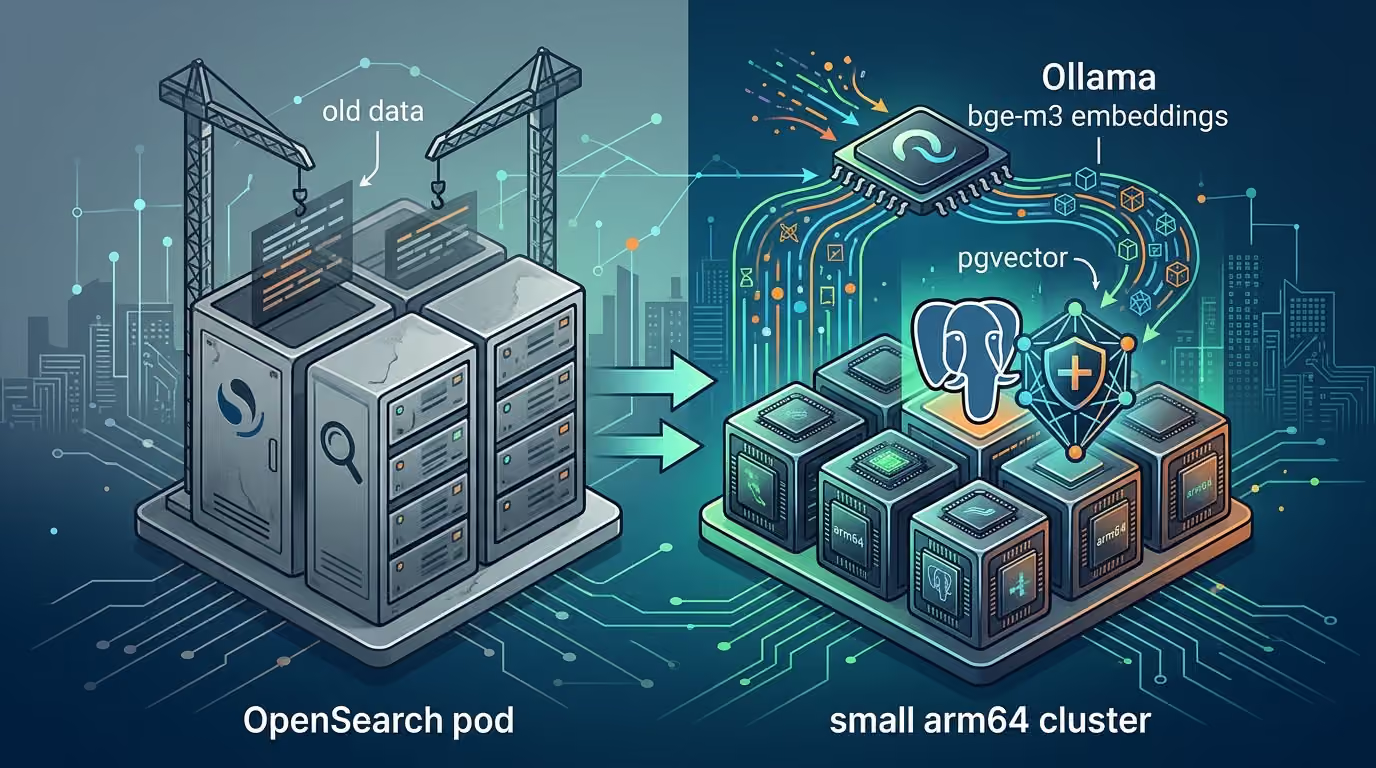
bge-m3 used to run in its own embeddings namespace, deployed by Terraform from the cluster repository. We moved it into rag for three reasons:
- One boundary to reason about. One
PeerAuthentication(STRICT), one default-denyAuthorizationPolicy, one Argo CDAppProjectwhose only destination israg. A service in another namespace needs an explicit rule to get in. - One release unit. bge-m3's model, its vector size (1024) and Qdrant's collection schema have to agree. Now they ship from the same repository.
- Short, predictable names. Every internal URL is
<service>.rag.svc.cluster.local, andrag-apireads them from environment variables.
The bge-m3 manifest came across almost unchanged: an init container downloads bge-m3:567m once onto a volume and refuses to serve if the weights don't match the pinned SHA-256 digest. The Service keeps the old Ollama port, 11434, next to the new 8001, so old callers only need a new host name.
Moving bge-m3: do the callers first
The move isn't finished, and the order we did it in is the lesson. The old embeddings release was switched off in the cluster repository (its Terraform files renamed to .tfbk) the same morning the new copy came up in rag. But two callers still had the old address:
moks-sre-agent's Hetzner values seed its embedding model ashttp://bge-m3.embeddings:11434.- seo-agent's ConfigMap says
OLLAMA_URL=http://bge-m3.embeddings:11434, and its NetworkPolicy only allows egress to namespaceembeddings.
seo-agent had just been switched from its in-process 384-dimension model to bge-m3. It's waiting for a full reindex into 1,024 dimensions, and until then "Ask the Blog" uses its fallback. That reindex can't reach bge-m3 now.
Readers haven't lost anything they had: Ask the Blog was already on its fallback, waiting for that reindex. But the right order is:
- Bring up the new copy. Check it returns 1,024-dimension vectors.
- Point every caller at
bge-m3.rag.svc.cluster.local:11434and move their egress rules to namespacerag. The new bge-m3 policies already allow both callers (seo-agent'sdefaultand MOKS'smoksservice accounts, checked on 26 November). - Watch the old pod's log until it gets no traffic.
- Only then delete the old release and namespace.
Where the sparse vectors come from
bge-m3 can produce three kinds of output: dense vectors, sparse lexical weights and multi-vector (ColBERT) representations. Ollama only serves the dense one. So the "sparse" side of our hybrid search doesn't come from bge-m3. rag-api builds it:
- It lowercases the text, drops a short stopword list and hashes each remaining token to a 32-bit index with BLAKE2b.
- Each index gets a BM25-style saturated term-frequency weight.
- Qdrant's sparse index applies
Modifier.IDF, so inverse document frequency is computed by Qdrant at query time, per collection.
That's plain BM25 keyword matching. It's not learned sparse retrieval, but it's what we wanted for exact tokens like CrashLoopBackOff, OOMKilled or an HTTP status code, which dense vectors tend to blur. There's a switch (SPARSE_MODE=bge_m3) for a server that does return bge-m3's lexical weights. Nothing on mk4 serves that today.
The hybrid query
This is the heart of rag-api's Qdrant client, trimmed:
prefetch_k = max(self._prefetch_limit, top_k * 3)          # 24 by default
prefetches = [
    models.Prefetch(query=dense_vector, using="dense",
                    limit=prefetch_k, filter=query_filter),
]
if sparse_vector.indices:                                  # a query of stopwords has none
    prefetches.append(models.Prefetch(
        query=models.SparseVector(indices=sparse_vector.indices,
                                  values=sparse_vector.values),
        using="sparse", limit=prefetch_k, filter=query_filter))

result = await self._client.query_points(
    collection_name=collection,                            # exactly one collection
    prefetch=prefetches,
    query=models.FusionQuery(fusion=models.Fusion.RRF),
    limit=top_k,                                           # 6 by default
    with_payload=True,
    query_filter=query_filter,
)
Qdrant does the fusion server-side, so there's one round trip and no score normalisation in Python. RRF uses ranks, not raw scores, which is why it can combine a cosine similarity and a BM25 score without tuning. The flip side: plain RRF weights both lists equally for every collection. More on that below.
Each collection is created with two named vectors: dense (1024, cosine) and sparse (with the IDF modifier). There's also a keyword index on doc_id, so deleting or replacing one document is a filtered delete, not a scan.
Three collections, one API

Every request names one collection, and the collection name is checked against a fixed list of three. That's the isolation unit:
| Service | Collection | What goes in | How it gets in (planned) | Retrieval |
|---|---|---|---|---|
moks-sre-agent | sre_knowledge | Runbooks, post-mortems, Kubernetes manifests | Its nightly knowledge sync posts each changed file to /ingest with a stable doc_id | Hybrid RRF. Exact error strings are what the sparse side is for. |
moks-cms | cms_content | Published articles | On publish: POST /ingest with the article's ID as doc_id. On unpublish or delete: DELETE /documents/<id>?collection=cms_content | Hybrid RRF |
moks-seo-agent | seo_intel, and reads cms_content | Audit notes, SERP and keyword research | Its own runs write seo_intel; it reads cms_content for internal links and keyword cannibalisation | Hybrid RRF, two calls (one per collection) |
| Open WebUI | one per virtual model | — | Read only | Three "models" in the picker: moks-sre, moks-cms, moks-seo-agent |
Some details make the CMS sync safe to retry:
- Point IDs are deterministic:
uuid5("<collection>:<doc_id>:<chunk index>"). Ingesting the same article twice produces the same points, not duplicates. - An upsert replaces the whole document.
rag-apideletes every chunk with thatdoc_idfirst, then writes the new ones. An article that shrinks from twelve chunks to eight leaves no orphans behind. The catch: delete-then-insert isn't atomic, so a query that lands in between won't find that article at all. - Every chunk records who wrote it.
ingested_byis set fromX-Service-Name.
For services that run their own models, there's include_answer: false. /query then returns the ranked chunks and doesn't call Claude. moks-sre-agent's crew and seo-agent's flows already have an LLM, and they don't need a second one writing a summary they'll throw away.
What isolation doesn't cover yet
Collections keep the data apart. They don't yet stop anyone reaching another service's data:
- There's one shared Bearer token. Any caller holding it can read or write any of the three collections.
X-Service-Nameis a claim, not an identity.rag-apilogs whatever the caller sends, so "which service did this" is only as honest as the callers.- The SRE collection gets no special weighting. "High sparse weight for
sre_knowledge" was in our design, but today every collection uses the same plain RRF. Changing that is cheap. Knowing whether it helps needs an evaluation set, and we don't have one for this corpus yet.
The fix for the first two is the same: one token per service, mapped in rag-api to the collections that service may read or write. That's the next change to rag-api, and it should land before the first service connects.
GitOps: GitHub Actions, Argo CD and Istio
The repository
moks-rag/
├── app/                     # rag-api: FastAPI source, tests, Dockerfile
├── deploy/
│   ├── k8s/                 # Kustomize: namespace, bge-m3, docling-serve, litellm,
│   │                        #   rag-api, open-webui, istio-routing (+ secret templates)
│   └── argocd/              # AppProject, two Applications, Qdrant values, CI RBAC
└── .github/workflows/
    ├── build-and-deploy.yaml      # app/** → test, image, tag bump
    └── deploy-argocd-apps.yaml    # deploy/argocd/** → apply the Argo CD objects
The loop

There are two workflows, one per kind of change.
build-and-deploy.yaml runs when app/** changes. It runs ruff and pytest, builds a multi-arch image (linux/arm64,linux/amd64, QEMU on a hosted runner), and pushes ghcr.io/mrjithendar/moks-rag-api:<sha> plus :latest. Then it rewrites newTag in deploy/k8s/kustomization.yaml and commits that to main with [skip ci]. Argo CD sees the commit and rolls out the new image. On 26 November the first build took 219 seconds, and the next one, with a warm cache, 88. Deploying by commit SHA means Git always says exactly which build runs, and a rollback is a git revert.
deploy-argocd-apps.yaml runs when deploy/argocd/** changes. It applies the AppProject and both Applications, forces a hard refresh, and waits until both report Synced and Healthy. It authenticates with a ServiceAccount token that is only allowed to create and patch AppProjects and Applications in namespace argocd.
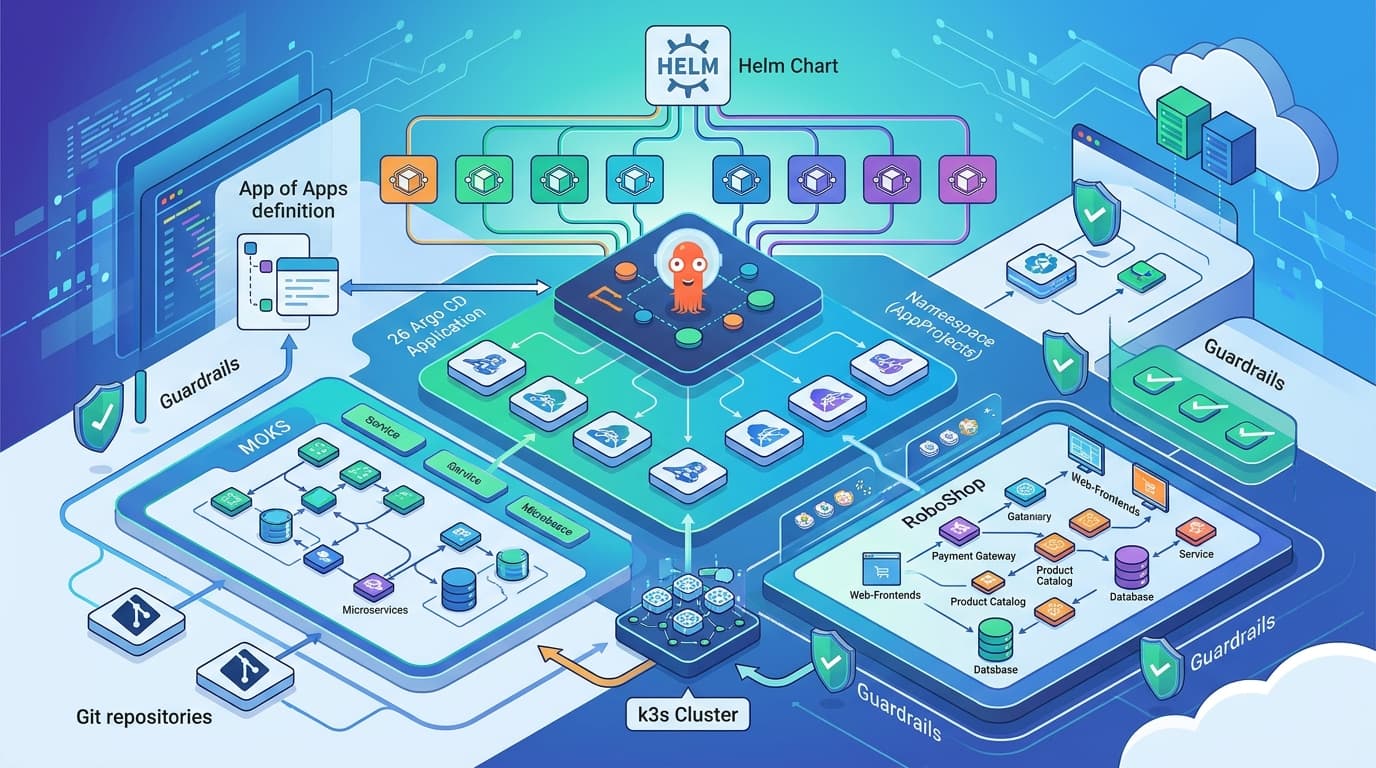
Argo CD owns two Applications:
moks-rag-stackrendersdeploy/k8swith Kustomize:prune: true,selfHeal: true,ServerSideApply=true.moks-rag-qdrantinstalls Qdrant's official Helm chart, with the values file taken from our repository. That's a multi-source Application:
apiVersion: argoproj.io/v1alpha1
kind: Application
metadata:
  name: moks-rag-qdrant
  namespace: argocd
spec:
  project: moks-rag
  sources:
    - repoURL: https://qdrant.github.io/qdrant-helm
      chart: qdrant
      targetRevision: "1.*"                # see "pin what you run" below
      helm:
        releaseName: qdrant
        valueFiles:
          - $values/deploy/argocd/qdrant-values.yaml
    - repoURL: https://github.com/mrjithendar/moks-rag.git
      targetRevision: main
      ref: values                          # names the second source "$values"
  destination:
    server: https://kubernetes.default.svc
    namespace: rag
  syncPolicy:
    automated: { prune: true, selfHeal: true }
    syncOptions: [CreateNamespace=true, PruneLast=true]
The moks-rag AppProject lists exactly two sources (this repository and Qdrant's chart repository), one destination (rag), and the resource kinds the stack uses. It deliberately leaves out Secret. rag-secrets (the Anthropic key, Qdrant's API key, LiteLLM's master key, rag-api's Bearer token and Open WebUI's session key) is created once with kubectl create secret. Argo CD never stores it, never shows it as drift and can never prune it. The repository has SealedSecrets and External Secrets templates for when we want that in Git too.
A gap we found while writing this: the CI token can create any Application in argocd, and an Application chooses its own project. On mk4 the default project allows every repository, every namespace and every cluster-scoped kind. So a leaked GitHub secret could create an Application in default that deploys anything anywhere. The token is effectively cluster-admin with an extra step. The fix belongs on the Argo CD side: restrict the default project (Argo CD lets you edit it, though not delete it) so it allows nothing, and the Role becomes as narrow as it looks.
Istio at the edge

jithendar.com has one root VirtualService in the cluster repository that delegates path prefixes to VirtualServices owned by each namespace. Adding the platform meant two lines there and one delegate VirtualService per route here:
# k8s-deployments: deploy/minikube/istio/edge/values.yaml
root:
  delegates:
    - {name: rag, prefix: /rag, to: rag/rag-api}
    - {name: chat, prefix: /chat, to: rag/open-webui}
---
# moks-rag: deploy/k8s/istio-routing.yaml (a delegate: no hosts, no gateways)
apiVersion: networking.istio.io/v1
kind: VirtualService
metadata:
  name: rag-api
  namespace: rag
spec:
  http:
    - name: rag-api-prefix
      match:
        - uri: { prefix: /rag/ }
        - uri: { exact: /rag }
      rewrite:
        uri: /
      route:
        - destination:
            host: rag-api.rag.svc.cluster.local
            port: { number: 8000 }
The gateway strips /rag, and FastAPI runs with root_path="/rag", so its generated links still point to the right place.
Authentication happens in rag-api, not at the gateway. Every endpoint except /health and /ready requires Authorization: Bearer <token>, compared in constant time. FastAPI's /docs, /redoc and /openapi.json are also open, so anyone can read the API's schema at https://jithendar.com/rag/docs (they still can't call anything). It's harmless, but it isn't what we meant. Production should set docs_url=None or put the docs behind the token.
Everything else stays internal. bge-m3, Qdrant, docling-serve and LiteLLM have no VirtualService. Inside the mesh, a default-deny policy plus a few ALLOW rules decide who talks to whom (plus one that lets Prometheus scrape the sidecars):
rag-apiaccepts the gateway,rag,moks-sreandjithendar.- Open WebUI accepts only the gateway.
- Qdrant, docling-serve and LiteLLM accept only namespace
rag. - bge-m3 accepts three named service accounts on one port.
Open WebUI: a subpath today, a subdomain next
Open WebUI runs at https://jithendar.com/chat/ today. Getting it there took more than a rewrite. The upstream image's SvelteKit frontend is built for /: its assets, API calls and Socket.IO path are all root-absolute. Our deployment mounts a small Python script that patches the built index.html and the JavaScript bundles at start-up. It prefixes those paths with /chat, and it wraps fetch, XMLHttpRequest, WebSocket and EventSource so that requests built at run time get the prefix too. It works. It's also the most fragile thing in the stack: it pattern-matches minified code in an image we pull as :main.
The plan is chat.jithendar.com. The patch is only one of three reasons:
- No patching. Open WebUI gets the root of its own host, which is what it's built for.
- Its own origin. Today Open WebUI shares an origin with the site and every admin tool on jithendar.com. That means they share cookies and
localStorage, and Open WebUI keeps its session token inlocalStorage. - Its own cache policy. The site's Cloudflare cache rule applies to
/ragand/chattoo, so a successful response without aCache-Controlheader is cached for an hour. On 26 November, Cloudflare served/rag/health,/rag/openapi.jsonand Open WebUI's/chat/api/configfrom cache. The cached config was 32 minutes old and still saidonboarding: true, although the admin account already existed. The endpoints we checked that need a login weren't cached (they answerno-storeor 401). But relying on every endpoint of an app we don't write to send the right header isn't a plan.
The cluster already uses this pattern: /harbor is a redirect to registry.jithendar.com, because Harbor can't live under a prefix either. /chat will go the same way. Until then, a Cloudflare cache rule that bypasses /rag* and /chat* closes the caching issue.
Sizing for CPU-only nodes
What each component asks for, what it actually held when idle on 26 November (before any real traffic), and where it landed:
| Component | Request (CPU / memory) | Limit (CPU / memory) | Idle memory | Node | Notes |
|---|---|---|---|---|---|
bge-m3 | 500m / 1.5 Gi | none / 2.5 Gi | 1.32 GiB | worker3 | No CPU limit on purpose: Ollama sizes its threads to the node's cores, and a CFS quota stalls batches. On 19 November this Ollama build embedded about 0.7 chunks/s on a cax21, one request at a time whatever OLLAMA_NUM_PARALLEL says. |
docling-serve | 250m / 1 Gi | 2 / 4 Gi | 0.87 GiB | worker3 | OMP_NUM_THREADS=2. The request was cut from 500m / 2 Gi so it would schedule at all. Large PDFs will use the 4 Gi. |
qdrant | 250m / 512 Mi | 2 / 2 Gi | 78 MiB | worker3 | Empty today. on_disk_payload: true keeps chunk text off the heap. 15 Gi leaves room to grow. |
litellm | 100m / 384 Mi | 1 / 1.5 Gi | 1.12 GiB | worker2 | OOMKilled at start-up (exit 137) with a 768 Mi limit. It idles at three times its request. |
rag-api | 150m / 256 Mi | 1 / 768 Mi | 124 MiB | worker1 | Read-only root filesystem, non-root, no service account token. |
open-webui | 200m / 512 Mi | 1 / 1.5 Gi | 0.86 GiB | worker1 | 2 Gi of data on local-path, which pins it to one node. |
Lessons from that table:
- Requests are what the scheduler believes. Together these pods request about 4.1 GiB and hold about 4.4 GiB while doing nothing. LiteLLM and Open WebUI hold 3× and 1.7× what they request. Worker3, home to bge-m3, docling-serve and Qdrant, has 93% of its memory requested. Set requests from what the pods actually hold, or the scheduler packs nodes on numbers that aren't true.
- Hetzner's CSI has a 10 Gi minimum. bge-m3's 5 Gi claim became 10 Gi. Open WebUI's 2 Gi stays on
local-path, so its data lives on one node. - One embedder is the throughput ceiling. At about 0.7 chunks per second, a 3,000-chunk corpus takes over an hour to embed. That's fine for nightly syncs and per-article updates, not for bulk reindexing during the day.
rag-apiembeds in batches of 32, which takes about 45 seconds, inside its 120-second HTTP timeout.
Security basics
- Secrets stay out of Git and out of Argo CD. As above,
rag-secretsis created by hand, and the AppProject can't manage Secrets. - The mesh is STRICT mTLS and denies by default. bge-m3 is the strictest: three named service-account principals, port 11434, GET and POST only. It also has a NetworkPolicy, so it stays closed even if someone deletes the mesh policy.
- Every request is logged with
X-Service-Name.rag-apiwrites one JSON line per request (request ID, service, method, path, status, duration), plus events for ingests, queries and chats. Those lines are what per-service usage and per-service token budgets will be built on. That part isn't built: LiteLLM runs with one master key,disable_spend_logs: trueand no database, and LiteLLM's per-key budgets need its database and one virtual key per caller. Since the header is self-declared (see "What isolation doesn't cover yet"), per-service tokens come first and budgets second. The budget numbers will be ours to set, not defaults in a manifest. - Open WebUI signup is off.
ENABLE_SIGNUP=falseandWEBUI_AUTH=true, and the live config confirms signup is disabled. Two details matter here:- Open WebUI always lets the first account sign up, as admin, whatever
ENABLE_SIGNUPsays. So create the admin account before the route goes public. Ours exists: one user, role admin. - Signup is one of the settings Open WebUI keeps in its own database after the first start. Changing the environment variable later does nothing; change it in the admin panel.
- Open WebUI always lets the first account sign up, as admin, whatever
- Open WebUI doesn't send
X-Service-Name, so its traffic is logged asunknown. It will get its own read-only token with the per-service change.
When rag-api is down
A shared platform is a shared failure. The rule for every caller is that losing rag-api costs them retrieval, not their own job.
What's in place:
rag-api's readiness probe (/ready) checks Qdrant. If Qdrant is gone,rag-apileaves the Service's endpoints, and callers get a fast 503 from the mesh instead of a hang.rag-apicreates its collections lazily. The two Argo CD Applications sync independently, and on the first deployrag-apistarted before Qdrant, so the start-up step that creates the collections failed once and never ran again. Now any request creates them if they're missing.
What each caller will do once connected (none of this is built yet):
| Caller | If rag-api is unreachable or slow |
|---|---|
moks-cms | Publishing never waits for rag-api. The sync runs after the publish is saved, retries with backoff, and is safe to repeat (deterministic point IDs, replace by doc_id). A periodic reconcile compares published article IDs with what's in cms_content and fixes the difference. |
moks-sre-agent | An investigation never fails because of retrieval. MOKS keeps its own pgvector knowledge base as a fallback, calls rag-api with a short timeout of its own, and records "shared knowledge base unavailable" as evidence so the answer says what it couldn't check. |
moks-seo-agent | Link and cannibalisation checks are advisory. If rag-api is down, the run skips them and says so in its report instead of failing. |
Lessons learned
- Move the callers, then delete the old service. Deleting the old
embeddingsrelease first left seo-agent unable to reindex and MOKS pointing at nothing. - Pin what you run. LiteLLM
main-latest,docling-serve-cpu:latestandopen-webui:mainall useimagePullPolicy: IfNotPresent, and the Qdrant chart tracks1.*. Which build runs depends on when each node first pulled it, and neither Argo CD nor a restart changes that. Our own image is deployed by SHA, and so is bge-m3. Do the same for the rest (a digest, or an exact version). - Independent Applications start in any order. If one service needs another at start-up, make it retry, not assume.
- Measure memory before you set limits. LiteLLM needed more than 768 Mi just to start.
- A subpath is a tax on apps built for
/. If an app doesn't support a base path, give it a host. - A CDN in front of an API needs its own rule. The site's cache rule was written for pages. It shouldn't apply to
/ragor/chatat all. - A "least-privilege" token is only as narrow as the default project. Check what Argo CD's
defaultAppProject allows before you hand anyone permission to create Applications.
What's next
- Connect the services, in this order:
moks-cms(writes only, easiest to verify), thenmoks-seo-agent(readscms_content), thenmoks-sre-agent. Per-service tokens land first. - Finish the bge-m3 move for MOKS and seo-agent, then run seo-agent's reindex.
- Close the gaps in this post: restrict Argo CD's
defaultproject, bypass Cloudflare's cache for/ragand/chat, hide/docs, pin image versions. - Move chat to
chat.jithendar.comand drop the start-up patch. - Measure, then tune. We'll add an evaluation set per collection (seo-agent already has
rag_eval.yamlfor the blog) before we try per-collection fusion weights. - Add a reranker. MOKS already runs one, and seo-agent has an int8 cross-encoder that's switched off. A reranker over the fused top 24 is the cheapest quality gain on CPUs, at a latency cost we'd measure first.
- Path B: a GPU node. A Hetzner GPU server joined to the cluster, running vLLM with an open model, added to LiteLLM's
model_listnext to Claude. The same node could serve bge-m3 with sparse output and a larger reranker.rag-apiwouldn't change, which is the point of putting LiteLLM in the middle.

Discussion comments
No comments yet. Start the discussion.