MOKS is the SRE agent and investigation portal I am building. An engineer asks a question about a namespace, and a LangGraph investigation collects live evidence from Kubernetes, Prometheus and Loki. It can also search the team's runbooks and postmortems. This article is about one small part of that search path, PyTorch RAG reranking: an optional internal service that uses PyTorch to reorder documentation passages before the agent sees them.
It is a narrow component. The service does not generate text, call tools, read the database or decide anything about an incident. It receives a question and a short list of passages that MOKS has already decided the caller may read. It returns ids and scores. Most of the engineering went into everything around that one forward pass: what reaches it, what happens when it is slow or wrong, and how to tell whether it helps.
I reviewed everything here against MOKS commit 4928f09 on 2 November 2026. I use four labels throughout:
- Implemented: behaviour I read in the code at that commit, usually with a test.
- Configured: a setting in the Helm values, which may differ per environment.
- Measured: a number recorded in the repository, given with the environment it came from.
- Not measured: anything I have no numbers for. I say so rather than estimate.
The short version
- The reranker is a FastAPI service called
moks-rerankerthat runscross-encoder/ms-marco-MiniLM-L6-v2with PyTorch on CPU, at a pinned revision baked into the image. - MOKS sends it at most 30 passages that already passed authorization and lifecycle checks in PostgreSQL. It gets back ids and scores, never text.
- Any failure, whether a timeout, overload, wrong model revision or malformed answer, leaves the existing order in place. Search never fails because of the reranker.
- Exact identifiers stay first and superseded documents stay last, whatever the model prefers. After reranking, PostgreSQL is asked again whether each document is still readable.
- On the one recorded evaluation, nDCG@5 went from 0.929 to 0.995. That run used a small synthetic dataset, keyword candidates only, on an arm64 Mac. It is a reason to keep testing, not proof that it helps real investigations.
The problem: related is not the same as the best evidence
Here is an illustrative example. It is not a recorded incident, and none of these documents are in a production index.
"Why are checkout pods failing to access S3?"
Suppose the knowledge base holds these four passages, among others:
- S3 access denied: a 403 from S3 with a valid identity is usually a bucket policy or a KMS key policy.
- IRSA:
AccessDeniedonsts:AssumeRoleWithWebIdentitymeans the role's trust policy does not match the service account. - EKS Pod Identity: if
AWS_ACCESS_KEY_IDis set in the pod, it outranks the Pod Identity association. - Pods restarting repeatedly: a CrashLoopBackOff runbook that says "pods" and "failing" several times.
Keyword search rewards shared words, so passage 4 does well on "pods" and "failing" even though it has nothing to do with S3. Vector search places all three AWS identity passages close together, because they are about the same topic. MOKS combines the two rankings with reciprocal rank fusion (RRF), which merges rank positions and knows nothing about meaning. All four are related to the question. Which one is the best evidence depends on how the question's words relate to each passage, and neither ranking looks at that.
A cross-encoder does. It reads the question and one passage together and scores how well that passage answers that question. That is the job I gave PyTorch.
Two details of the example matter for MOKS specifically. First, "S3" is too short to count as an exact identifier: MOKS only extracts identifiers of four characters or more (see identifiers). So nothing in this question is protected from reordering. Second, the recorded synthetic evaluation contains near copies of these passages, and the result there was mixed. The correct passage was already first for all three AWS identity questions, with or without reranking. For "getting 403 reading an encrypted object from the bucket", reranking moved an OpenSearch disk watermark runbook up to second place, presumably because it also mentions a 403. A model trained on web search questions does not know which 403 an operator means.
Where reranking did help in that run, the pattern was this:
| Question (synthetic) | Top 3 without reranking | Top 3 with reranking |
|---|---|---|
| pod terminated with exit code 137 | crashloop, pod-identity, pending | oom, crashloop, selector |
| ingress returns 503 even though the pods are running | pod-identity, readiness, pending | readiness, crashloop, pending |
The keyword ranking put the Pod Identity runbook near the top of both questions because it uses the word "pod" a lot. The cross-encoder fixed that.
Where PyTorch fits, and where it does not
Several pieces in a RAG system are easy to mix up, so here is each one and what it does in MOKS.
- Embedding model. It turns a text into a vector, a list of numbers, so that similar texts get nearby vectors. The query and each passage are encoded separately, which is why passage vectors can be computed once at indexing time. In MOKS this is an external provider an administrator configures, and it is optional: without one, search runs on keywords and identifiers only.
- Vector index. It stores those vectors and finds the nearest ones quickly. MOKS uses pgvector in PostgreSQL or an optional OpenSearch index. Either way, the index only suggests candidates. PostgreSQL decides what is readable.
- Cross-encoder reranker. One transformer reads the query and a passage together and outputs a single relevance score. It sees how words in the question relate to words in the passage, which separate vectors cannot. The cost is that nothing can be precomputed: every query and passage pair is a fresh forward pass. That is why it only ever sees a short list.
- The LLM. It plans which tools to call and writes the report. It runs at an external provider, and the reranker never talks to it.
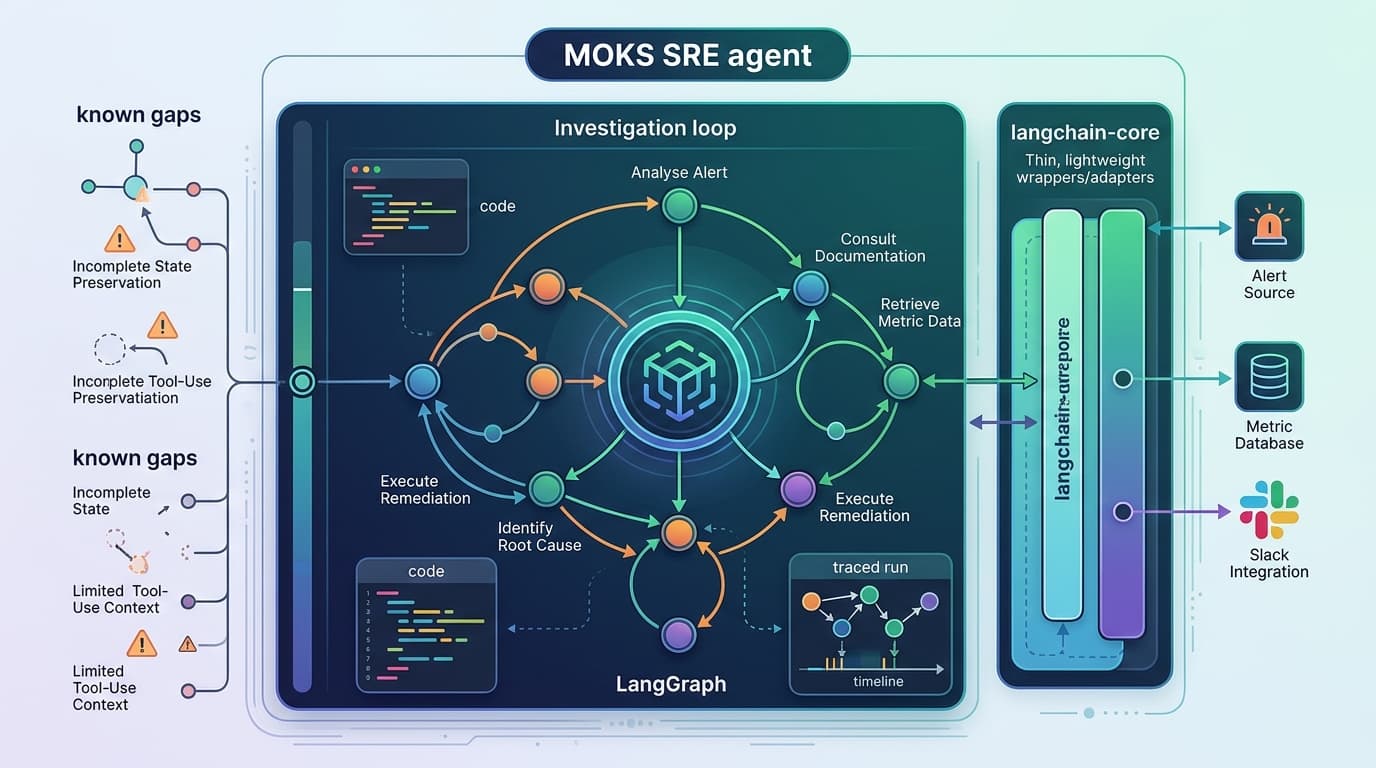
- LangGraph and LangChain. The investigation is a LangGraph state machine (
triage → logs → skills → plan ⇄ act → correlate → report), and langchain-core provides thin adapters. I covered that in LangChain vs LangGraph for an SRE agent. Search, including reranking, is an ordinary tool theplannode may ask for. - Reviewed SRE skills. These are versioned
SKILL.mdplaybooks, selected by publication state, environment policy, connectors and permissions. Reranker scores play no part in selecting them. The RAG and skills article describes how that works.
PyTorch runs the cross-encoder's forward pass, and nothing else in MOKS. It does not replace the vector index, the agent, authorization or any remediation control.
The actual model
The repository pins cross-encoder/ms-marco-MiniLM-L6-v2 at revision 233902d25c440f23af6f7d6e94d2946bac0bee0a in reranker/model.lock.json. I checked its config.json at that revision rather than assume a structure:
| Property | Value |
|---|---|
| Architecture | BertForSequenceClassification, a BERT encoder with a classification head |
| Size | 6 layers, hidden size 384, 12 attention heads |
| Output | one label, so one raw score (a logit) per pair |
| Input | 512 positions for query and passage together |
| Training | MS MARCO passage ranking, which is web search queries, not operations documents |
| Language | English |
| License | Apache-2.0, according to the model card |
The model card reports NDCG@10 74.30 on TREC DL 2019 and MRR@10 39.01 on MS MARCO dev. Its throughput figure of 1,800 documents per second was measured on a V100 GPU and says nothing about CPU inference in a pod.
The service loads the model through sentence-transformers' CrossEncoder (6.2.0) on torch==2.15.0+cpu, pinned in reranker/requirements.txt.
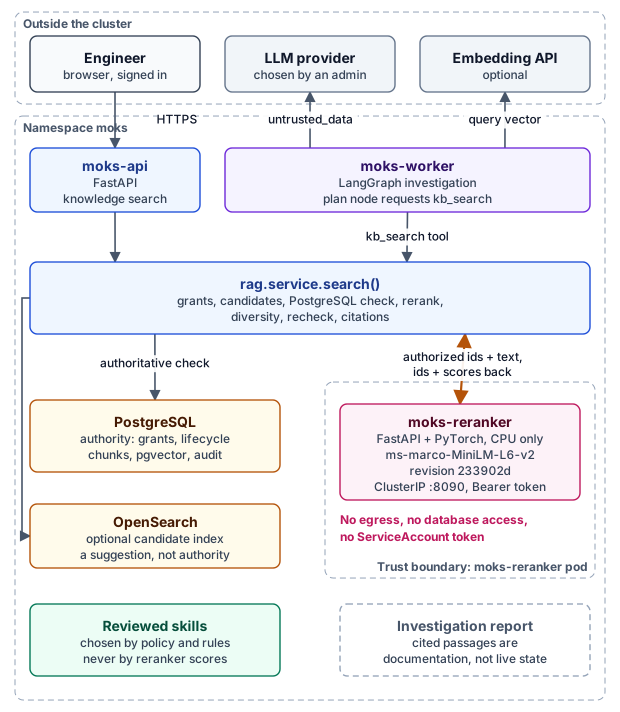
The end-to-end request flow
The order below follows search() in backend/moks/rag/service.py. The function's docstring lists the same order, and I checked it line by line.
- Question and authorized scope. The
plannode asks forkb_search, which passes the investigation's principal, environment and focus namespace.access.grants()turns that into the bindings the caller holds for this scope. No grants means an empty answer. - Candidate retrieval.
_rankingscollects a keyword ranking, an exact-identifier ranking that is counted twice, optional ranked sub-questions, and a vector ranking when embeddings are available. RRF fuses them. The pool starts atmax(k * 4, 20)and grows threefold, up to 400, when unreadable or retired rows crowd out the readable ones. - Authorization and lifecycle. PostgreSQL returns only chunks whose document and source are active and in the current realm. Each one then passes
access.can_readandaccess.in_requestfor the requested environment and namespace, and stale documents are dropped where the source's policy says to exclude them. The comment in the code says it directly: "what the index said is only a suggestion." - Small scoring signals.
_scoreadds small adjustments to the fused score:+0.03per exact identifier found, smaller boosts for service, resource type, scope and reviewed authority, and penalties for stale or superseded documents. - Candidate preparation.
_preparefills a window of up to 30 rows, with at most 4 chunks from any one document and no identical text twice. Rows that do not fit stay in their existing order after the window. - Internal reranker request. The client sends each chunk's heading and text with an opaque id. It clips the query to 1,000 characters and each passage to 2,000, and sets a 1,500 ms deadline.
- Model scoring. The service scores every pair and returns ids, scores and the model revision.
- Validation and context selection. The answer is refused unless it scores exactly the ids that were sent. The order is then constrained, and
_selectkeeps at most 3 passages per document and drops near duplicates within one scope. - Final access and content check.
_finish_rerankingreloads the documents from PostgreSQL. The round trip took time, and a document may have been quarantined or had its access changed meanwhile. Anything no longer usable is removed and counted inremoved_after_recheck. This runs only when reranking was applied, because only then has extra time passed. - Citations and the LLM.
kb_searchremoves the per-chunk ranking details before the passages go to the model (# for the evidence view, not for the model). It returns passages with citations to the source, path, revision and lines. The prompt builder wraps them in<untrusted_data>blocks, and the evidence layer classifies them as documentation rather than observations of the live system. One small wrinkle: each passage still carries itsscorefrom before reranking, so after reranking the scores the model sees are no longer in descending order. The order of the list is what changed, not the numbers.
The decision to rerank is three lines in search():
# backend/moks/rag/service.py
    client = reranker or reranking.active()
    applied: dict | None = None
    if rerank is not False and client is not None and scored:
        scored, applied = await _apply_reranker(client, scored, query)
    results = _select(scored, min(k, get_settings().rag_rerank_results, reranking.MAX_RESULTS) if applied else k)
    if applied:
        results = await _finish_reranking(db, principal, results, applied, environment, namespace)
reranking.active() returns None unless the feature is enabled and a URL, model id and revision are all set. With no client, search runs exactly as it did before the feature existed.
What the model is not allowed to override
_apply_reranker does not simply sort by the model's score:
# backend/moks/rag/service.py
    before = {r[2]: i for i, r in enumerate(scored)}
    ordered = sorted(window, key=lambda r: (-got.scores[r[2]], before[r[2]]))
    pinned = sorted([r for r in ordered if "exact_identifier" in r[1]], key=lambda r: before[r[2]])
    held = [r for r in ordered if "exact_identifier" not in r[1]]
    final = pinned + [r for r in held if r[6] not in ("superseded", "deprecated")] + [r for r in held if r[6] in ("superseded", "deprecated")] + rest
Any passage that literally contains an identifier from the question stays ahead of everything else, in its original order. If an engineer pastes ERR_PAY_4071 or FailOnSharedResource, matching that string is the whole reason the passage was found, and a model trained on web queries should not argue with it. Superseded and deprecated documents go after current ones. Ties fall back to the previous order, so the result is deterministic.
There is a trade-off. The pin is a substring match, so a question containing a common identifier such as AccessDenied pins every passage that mentions it, and the model can only reorder whatever is left.
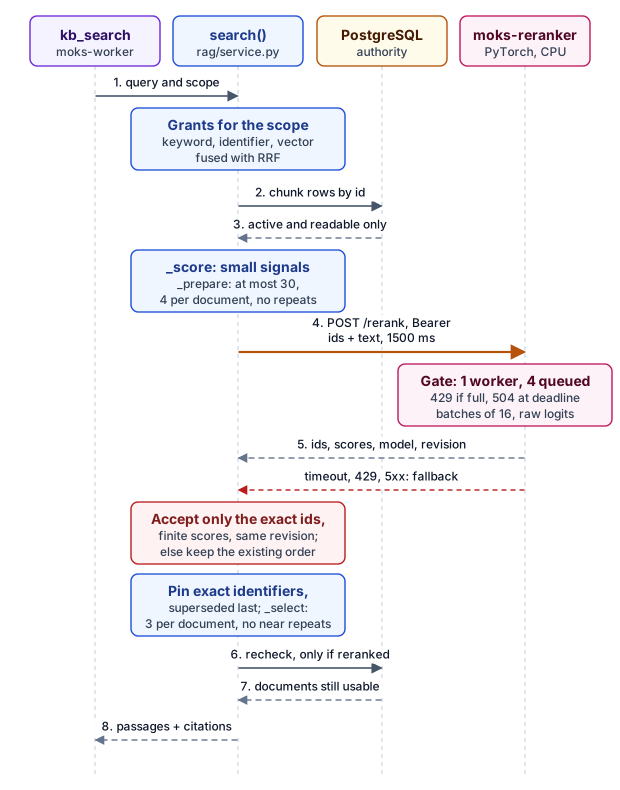
The inference service
The whole service is three files under reranker/: app.py for HTTP, engine.py for the model and capacity, and schemas.py for the wire format. engine.py has no web framework in it, so the capacity logic can be tested without one.
Endpoints and request schema
There are three routes, and the generated OpenAPI and docs pages are turned off:
| Route | Purpose |
|---|---|
GET /healthz | Liveness: the process is up |
GET /readyz | Readiness: 200 with the model id and revision once loaded and warmed up, otherwise 503 with the error type |
POST /rerank | Score candidates; needs Authorization: Bearer <token> |
The service refuses to start without RERANKER_TOKEN; it has no unauthenticated mode. Requests are strict Pydantic models with extra="forbid", so a request cannot add a model, model_path or trust_remote_code field. Ids must match ^[A-Za-z0-9_-]+$ and must be unique. schemas.py sets hard ceilings that deployment settings can lower but never raise:
| Limit | Ceiling in code | Configured on mk4 |
|---|---|---|
| Candidates per request | 50 | 30 |
| Query characters | 2,000 | 1,000 |
| Passage characters | 8,000 | 2,000 |
timeout_ms | 10 to 30,000 | client sends 1,500 |
FastAPI's default validation error echoes the rejected input, and here the input is operational documentation. The service replaces that handler with one that returns only the location and type of each error. A test checks that rejected text never appears in the response.
Model loading and warm-up
The model loads in FastAPI's lifespan handler, off the event loop with asyncio.to_thread. A warm-up call follows, so the first real request does not pay for lazy initialization. If loading fails, the process stays up, /readyz returns 503 with the exception type, and a load-failure counter goes up. That way a broken image shows up in the probe output instead of as a crash loop with no explanation.
# reranker/engine.py
        torch.set_num_threads(self._threads)
        try:
            torch.set_num_interop_threads(1)
        except RuntimeError:  # already fixed in this process
            pass
        self._identity = torch.nn.Identity()
        self._encoder = CrossEncoder(str(self.path), device="cpu", max_length=self.max_length, local_files_only=True, trust_remote_code=False,
                                     activation_fn=self._identity, model_kwargs={"use_safetensors": True})
        self._encoder.eval()
Here is what each setting does:
torch.set_num_threadssets the threads used within one operation, such as a matrix multiply ("intraop parallelism" in the PyTorch docs). It comes fromRERANKER_THREADSand is 2 by default.torch.set_num_interop_threads(1)limits parallelism between independent operations. PyTorch allows it to be set only once, before any inter-op work starts, which is why aRuntimeErroris tolerated.device="cpu"is reinforced by the install. torch comes from the CPU wheel index, so no CUDA libraries are in the image.local_files_only=Trueandtrust_remote_code=False: the weights must already be on disk, and no Python code from a model repository is ever executed.use_safetensors=True: the weights are read frommodel.safetensors, a format that stores tensors without pickle. Loading a pickled PyTorch checkpoint can execute code. Loading safetensors cannot.activation_fn=Identitykeeps raw logits. The CrossEncoder docs say that when no activation is given, a sigmoid is used for single-label models. A sigmoid squeezes scores into 0 to 1, which makes them look like probabilities when they are not. This model'sconfig.jsonat the pinned revision already declares an identity activation, so the explicit setting mainly guarantees the same behaviour across library versions.
Scoring, batching and truncation
# reranker/engine.py
        query_tokens = self._tokens(query)
        room = self.max_length - query_tokens - self._tokenizer.num_special_tokens_to_add(pair=True)
        truncated = [cid for cid, text in candidates if self._tokens(text) > room]
        scores: list[float] = []
        for start in range(0, len(candidates), self.batch_size):
            if time.monotonic() > deadline:
                raise Expired()
            batch = candidates[start:start + self.batch_size]
            out = self._encoder.predict([(query, text) for _, text in batch], batch_size=self.batch_size, show_progress_bar=False, activation_fn=self._identity, convert_to_numpy=True)
            scores += [float(s) for s in out]
Candidates are scored in batches of RERANKER_BATCH_SIZE, 16 by default, so 30 candidates make two forward passes. The deadline is checked between batches. A batch that has started cannot be interrupted, so the worst-case overrun is about one batch.
The model takes 512 tokens for the query and passage together. Before scoring, the service counts tokens and reports which ids will not fit, and the tokenizer then cuts those pairs. MOKS has already clipped passages to 2,000 characters, and it records both kinds of cut separately: clipped for its own and truncated for the service's. The result marks such passages as partially_scored. One limitation of the report is that the token count assumes only the passage is cut. That holds when the question is short.
Bounded capacity
The service accepts at most RERANKER_CONCURRENCY running requests plus RERANKER_QUEUE waiting ones, 1 and 4 by default. Beyond that it answers 429 with Retry-After: 1 immediately, rather than letting requests pile up behind a CPU-bound model.
# reranker/engine.py
    def submit(self, fn: Callable[[float], Any]) -> concurrent.futures.Future:
        """`fn` receives how long the work waited in the queue."""
        with self._lock:
            if self._closed or self._held >= self.capacity:
                raise Overloaded()
            self._held += 1
        queued_at = time.monotonic()
        try:
            future = self._pool.submit(lambda: fn(time.monotonic() - queued_at))
        except RuntimeError:
            self._release()
            raise Overloaded() from None
        future.add_done_callback(lambda _: self._release())
        return future
The important line is the last callback: a slot is released when the computation finishes, not when the HTTP request ends.
Deadlines, timeouts and cancellation
# reranker/app.py
        try:
            future = gate.submit(work)
        except Overloaded:
            REQUESTS.labels("overloaded").inc()
            raise HTTPException(429, "at capacity", headers={"Retry-After": RETRY_AFTER_SECONDS}) from None
        HELD.set(gate.held)
        try:
            # shield: a cancelled handler stops waiting and the work keeps its slot until it is really over
            scored, waited, took = await asyncio.wait_for(asyncio.shield(asyncio.wrap_future(future)), max(deadline - time.monotonic(), 0))
        except (TimeoutError, asyncio.TimeoutError, Expired):
            REQUESTS.labels("timeout").inc()
            raise HTTPException(504, "deadline exceeded") from None
When the deadline passes, the handler stops waiting and returns 504. The model thread keeps running, because Python cannot stop a thread inside a native PyTorch call. That is why a timed-out request must not free its slot. If the slot followed the HTTP request, every timeout would admit a new request while the CPU was still busy with the old one. Under load, a service with "one worker" would then run many computations on the same two threads, every one would get slower, more would time out, and the cycle would feed itself. Tying the slot to the computation keeps the service's real concurrency at what was configured.
The same reasoning covers a client that disconnects. asyncio.shield means cancelling the handler cancels only the wait, not the work. Work that waited in the queue past its deadline never starts: the work function checks the deadline before it calls the model. Tests cover all three cases: test_a_timed_out_request_keeps_its_slot_until_the_work_ends, test_a_cancelled_caller_does_not_free_a_running_slot and test_work_past_its_deadline_never_starts.
The output is checked before it leaves the service. There must be exactly one score per candidate, and none may be NaN or infinite. Otherwise the answer is a 500, not a ranking.
Graceful shutdown
Uvicorn runs with timeout_graceful_shutdown set from RERANKER_DRAIN_SECONDS, 20 by default, and the pod's terminationGracePeriodSeconds is that plus 10. On shutdown, the lifespan handler marks the service not ready and calls gate.close(), which refuses new work and waits for accepted work to finish.
One gap. As I read Uvicorn's shutdown order, it stops accepting connections before the lifespan shutdown runs, and the chart has no preStop delay. So for a moment, Kubernetes may still send connections to a pod that is no longer listening. In MOKS this is harmless, because the client treats a refused connection as unavailable and keeps the existing order. Still, it is not a strict drain, and I would add a short preStop sleep before calling it one.
Metrics and logging
The service exposes Prometheus metrics on port 9464: reranker_requests_total{outcome}, reranker_queue_wait_seconds, reranker_inference_seconds, reranker_candidates, reranker_truncated_passages_total, reranker_slots_held and reranker_model_load_failures_total. Logs are JSON events with a request id, counts and durations. Queries and passages are never logged and never appear in a metric label, and a test checks that.
Model artifacts and reproducibility
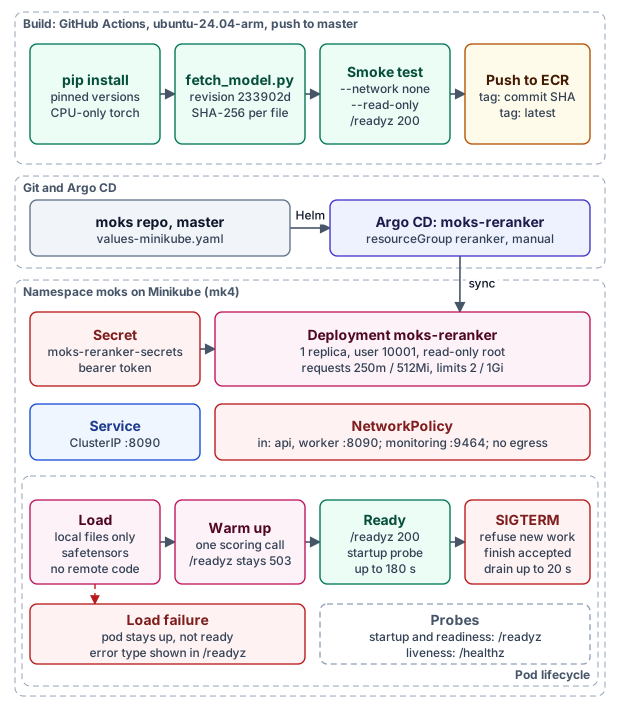
The model is part of the image, not something a pod downloads. fetch_model.py runs once, at build time. It downloads exactly the files listed in the lock file at the pinned revision and compares each file's SHA-256 with the lock. A mismatch fails the build.
# reranker/Dockerfile
COPY requirements.txt fetch_model.py model.lock.json ./
RUN pip install --prefix=/install -r requirements.txt
RUN PYTHONPATH="$(python -c 'import site,sys;print("/install/lib/python%d.%d/site-packages" % sys.version_info[:2])')" python fetch_model.py model.lock.json /opt/model \
 && rm -rf /opt/model/.cache && cp model.lock.json /opt/model/
The runtime stage copies the installed packages and /opt/model, sets HF_HUB_OFFLINE=1 and TRANSFORMERS_OFFLINE=1, and runs as UID 10001. At startup, Model.load() refuses to continue if model.lock.json is missing, and the service reports the lock's model id and revision on /readyz and in every response. MOKS compares those with its own configuration, which is described below.
What is pinned, and what is not:
- Pinned: the model revision and the hash of every model file; every Python package with
==, including transitive ones; torch as a CPU-only build. - Not pinned: the
python:3.12-slimbase image is a tag, not a digest, andpip installdoes not use--require-hashes. So the package versions are reproducible, but the package bytes are not verified. Both would be easy to tighten.
The CI job reranker-image runs on every push to master on an arm64 runner. It builds the image and starts it with --network none, --read-only and the non-root user, then waits for /readyz, so a model that tried to download at runtime would fail here. It then pushes a commit-SHA tag and latest. Only arm64 is built, because every node in my Minikube cluster is arm64.
Updating the model, as documented in docs/RERANKING.md: put the new revision and hashes in model.lock.json, rerun the evaluation, push, set reranker.model.revision in the Helm values, and restart the reranker, the API and the worker. Until the revisions agree, MOKS refuses the service's answers and keeps its existing order. A half-finished upgrade therefore turns reranking off rather than mixing models.
Rolling back means pointing latest at an earlier commit tag and restarting, or setting reranker.image.digest. With latest and imagePullPolicy: Always, two replicas can run different builds until both restart. Setting a digest avoids that.
On licensing: the model card states Apache-2.0. I have not reviewed the terms of the MS MARCO training data. If that matters for how you use the model, check them yourself.
MOKS integration and fallback
The client lives in backend/moks/rag/rerank.py. Its docstring sets the rule: "never a reason for a search to fail".
Two switches
| Helm value | Effect | Default | mk4 at 4928f09 |
|---|---|---|---|
reranker.enabled | Deploys the service and writes its URL, model and revision into MOKS's ConfigMap | false | true |
reranker.client.enabled | Sets MOKS_RAG_RERANK_ENABLED, so search actually calls the service | false | true |
They are separate so the service can run and be evaluated before anyone's results change. Turning only the client off, or stopping the service, is a complete rollback.
Authentication
The service checks the bearer token with hmac.compare_digest, a constant-time comparison. The token lives in a Kubernetes Secret, moks-reranker-secrets, under the key MOKS_CRED_RERANKER_TOKEN, and the same value goes into the API and worker Secret. Because there is one shared token, rotating it means changing both Secrets and restarting all three components. Calls in between fail with 401 and fall back.
Response validation
# backend/moks/rag/rerank.py
    def _parse(self, body: Any, sent: list[str]) -> dict[str, float] | str:
        """Anything unexpected is refused whole: a partial ranking cannot be told from a wrong one."""
        if not isinstance(body, dict) or not isinstance(body.get("results"), list) or not isinstance(body.get("model"), dict):
            return "invalid_output"
        if body["model"].get("id") != self.model or body["model"].get("revision") != self.revision:
            return "model_mismatch"
        scores: dict[str, float] = {}
        for row in body["results"]:
            if not isinstance(row, dict) or set(row) != {"id", "score"}:
                return "invalid_output"
            cid, score = row["id"], row["score"]
            if cid in scores or cid not in sent or isinstance(score, bool) or not isinstance(score, (int, float)) or not math.isfinite(score):
                return "invalid_output"
            scores[cid] = float(score)
        return scores if set(scores) == set(sent) else "invalid_output"
MOKS checks everything the service already checks, because it does not trust the service either. The answer is all or nothing: a missing id, an extra id, a duplicate, a non-finite score or a different model revision rejects the whole answer.
The circuit breaker
# backend/moks/rag/rerank.py
    def _failed(self, reason: str, seconds: float = OPEN_SECONDS) -> Outcome:
        self._failures += 1
        if self._failures >= FAILURES_TO_OPEN:
            self._open_until = self._clock() + seconds
        self._count(reason)
        return Outcome(reason=reason)
After 5 consecutive failures, the client stops calling for 30 seconds. Or, if the last failure was a 429, for the service's Retry-After, capped at 30 seconds. While open, searches skip the call and report circuit_open. After the window, the next search tries again. The failure count resets only on success, so one more failure reopens the circuit straight away, which works much like a half-open state.
Three details are worth knowing:
- The breaker lives in each process, so every API and worker process has its own count.
- A single
429does not pause calls.Retry-Afteronly sets the length of the pause once the fifth failure opens the circuit. - There are no retries. A failed call costs one search the reranking, nothing more.
What fallback looks like
Every search response carries a reranking block. Its state is applied or fallback, with a reason such as timeout, overload, unavailable, auth, model_mismatch, invalid_output or circuit_open, along with the model, the revision and timings. The public knowledge API shows ordinary users only state and the standard note. Index administrators see the rest, plus a status page backed by GET /knowledge/reranking.
Fallback is tested, not just assumed. In the backend tests, test_service_refusals_keep_the_existing_order covers 429, 504, 503, 500 and 401, and test_a_malformed_answer_changes_nothing and test_a_changed_model_revision_is_not_trusted cover bad answers. Each compares the chunk ids with a search that has reranking off. The RAG evaluation gates do the same for its first five labelled questions, using a reranker that always times out.
Kubernetes deployment
Everything is in one Helm template, deploy/helm/moks/templates/reranker.yaml. It belongs to the reranker resource group, so one Argo CD Application can render just those resources. When reranker.enabled is true, it creates:
- ServiceAccount
moks-rerankerwithautomountServiceAccountToken: false. The pod has no Kubernetes API credentials. - Service
moks-reranker, typeClusterIP, port 8090. There is no Ingress and no VirtualService. - Deployment
moks-reranker, running as UID and GID 10001 with aRuntimeDefaultseccomp profile, a read-only root filesystem, all capabilities dropped and a 64 MiBemptyDirfor/tmp. - NetworkPolicy that admits only pods labelled as the MOKS API or worker on 8090, and the configured metrics namespaces on 9464, with
egress: []. The pod can open no outbound connections at all. - AuthorizationPolicy, only when Istio mTLS is enabled, naming the API and worker service accounts.
The template refuses to render without an image tag or a well-formed digest.
The base values set the service's knobs and its resources:
# deploy/helm/moks/values.yaml
  replicas: 1
  threads: 2
  batchSize: 16
  concurrency: 1
  queue: 4
  maxCandidates: 30
  maxQueryChars: 1000
  maxPassageChars: 2000
  drainSeconds: 20
  # PROVISIONAL: from an arm64 Mac (peak about 480 MiB, under 1 CPU-second per request). Measure on the
  # cluster before relying on these. docs/RERANKING.md has the method.
  resources:
    requests: {cpu: 250m, memory: 512Mi}
    limits: {cpu: "2", memory: 1Gi}
The comment says "provisional", and it means it. The requests and limits came from a laptop. The only in-cluster number I have is a single kubectl top reading at idle: 3m CPU and 443 MiB of memory, taken while writing this. That is a snapshot, not a load measurement, but it does say the pod sits close to its 512 MiB request with no work at all.
Probes:
| Probe | Path | Settings |
|---|---|---|
| startup | /readyz | every 5 s, up to 36 failures, so 180 s to load and warm up |
| readiness | /readyz | every 10 s |
| liveness | /healthz | every 20 s |
Liveness uses /healthz, not /readyz, on purpose. A pod whose model failed to load stays up and unready, so the error stays readable instead of being restarted away.
Minikube and EKS
On my Minikube cluster (profile mk4), values-minikube.yaml turns both switches on:
# deploy/helm/moks/values-minikube.yaml
# docs/RERANKING.md. CI moves latest on every master build, and a pod gets it when it restarts.
reranker:
  enabled: true
  image:
    tag: latest
  client:
    enabled: true
The Argo CD Application moks-reranker renders the chart with resourceGroup: reranker and is synced by hand, never with prune. values-eks.yaml keeps reranker.enabled: false, and the EKS Application sits in deploy/argocd/eks/optional/, to be moved into apps/ only when it is enabled. The EKS configuration exists but has never run the reranker.
docs/RERANKING.md says NetworkPolicy enforcement on mk4's CNI is unverified. Until it is checked, the bearer token is the control I know holds there.
Building and enabling
These steps come from the repository. Building and configuring come first, and enabling is separate.
Build and test locally (needs a container runtime; <model-dir> is a directory produced by fetch_model.py):
cd reranker
pip install -r requirements-test.txt
python -m pytest tests -q
docker build --build-arg GIT_COMMIT=dev -t moks-reranker:dev .
docker run --rm -e RERANKER_TOKEN=dev -e RERANKER_METRICS_PORT=0 \
  --network none --read-only --tmpfs /tmp --user 10001:10001 moks-reranker:dev
python benchmark.py <model-dir>   # CPU latency and memory on your machine
Configure (cluster-specific values are placeholders):
- Create the ECR repository
moks-reranker(Terraform in my case) and let CI push an image. - Generate a token (
openssl rand -hex 32), then fill in a copy ofdeploy/secrets/moks-reranker-secrets.example.yamland apply it to namespacemoks. Put the same value underMOKS_CRED_RERANKER_TOKENin the API and worker Secret. - Set
reranker.enabled: trueandreranker.image.repository: <account>.dkr.ecr.<region>.amazonaws.com/moks-reranker, and preferablyreranker.image.digest. - Sync the foundation and
moks-rerankerApplications, restart the API and worker so they read the new ConfigMap, and check the Reranking panel under Knowledge, Index health.
Enable for searches, only after evaluating:
- Run the
rerankevaluation (next section), and measure real CPU and memory. - Set
reranker.client.enabled: true, restart the API and worker, and watchmoks_rerank_calls_totalby outcome.
Evaluation and results
How the comparison works
backend/moks/evals/rerank_eval.py runs the same questions through search() twice, once with reranking off and once with a real service. It does this in an isolated evaluation realm: it indexes the dataset's documents under throwaway sources, first proves that operational searches cannot see them, and deletes them afterwards. The rankings are compared at the document level:
- Recall@k: the share of relevant documents that appear in the top k (k = 3 and 5).
- MRR, mean reciprocal rank: 1 divided by the position of the first relevant document, averaged over the questions.
- nDCG@5, normalized discounted cumulative gain: rewards relevant documents near the top, with yes-or-no relevance.
- Diversity: distinct documents in the top 5.
- Latency: end-to-end search time p50 and p95 for both modes, plus inference time reported by the service.
Five safety gates must pass on every run: no forbidden document appears, citations of passages present in both modes are unchanged, exact-identifier questions put the right document first, the abstention decision does not change, and no case fell back unexpectedly. The dataset also sets rollout thresholds: nDCG and MRR gains of at least 0.02, no recall loss, at most 0.02 diversity loss and at most 300 ms of added p95 latency. A pass marks reranking "eligible to enable". Nothing in the evaluation turns it on.
Recorded results
The repository holds one recorded run, docs/examples/rerank-evaluation-2026-11-02.json. Its context first:
- Dataset:
rerank.yaml, with 29 short synthetic runbook passages and 30 questions, 27 of which have relevance labels. They were written for this evaluation, not collected from operators. - Model:
cross-encoder/ms-marco-MiniLM-L6-v2at233902d, the same pin as production. - Environment: arm64 macOS, torch 2.15.0, Python 3.11, 2 threads. The service ran on a laptop, not in the cluster.
- Candidates: keyword search only. The evaluation realm has no vectors, and production uses them.
| 27 labelled questions | Reranking off | Reranking on |
|---|---|---|
| nDCG@5 | 0.929 | 0.995 |
| MRR | 0.917 | 1.000 |
| Recall@3 | 0.944 | 0.982 |
| Recall@5 | 0.982 | 1.000 |
| Document diversity | 1.00 | 1.00 |
| Search latency p50 / p95 | 2.7 / 4.6 ms | 35.0 / 68.8 ms |
| Inference p50 / p95 | 20.8 / 39.7 ms |
Every gate passed. Only four questions changed their scores, and all four improved: the exit-code-137 and 503 questions shown earlier, "services sometimes fail to resolve hostnames inside the cluster", and "sync fails because two apps own the same resource". Many other questions had lower positions reordered without affecting the metrics. docs/RERANKING.md also records that with the service stopped, the same run returned exactly the reranking-off results and the gates said "keep disabled".
I read this as a reason to test further and nothing more:
- Thirty synthetic questions written alongside the feature cannot represent what engineers actually type during an incident.
- Keyword-only candidates leave out the vector candidates that production retrieval also uses.
- The passages are short, so the latency here is far below what long passages cost (see below).
- The
long_passagecase was meant to test truncation, but the chunker had already split that document.truncated_passageswas 0, so the effect of truncation on quality is unmeasured. - The rollout thresholds are starting values, not derived from anything.
- The evaluation client uses the 5,000 ms timeout ceiling, not the 1,500 ms production setting, so it would not show production timeouts.
Recorded CPU benchmarks
docs/RERANKING.md records benchmark.py results from the same arm64 Mac, with 2 threads and batch size 16:
| Candidates × passage length | p50 | p95 |
|---|---|---|
| 10 × 800 characters | 88 ms | 89 ms |
| 30 × 200 characters | 72 ms | 73 ms |
| 30 × 800 characters | 262 ms | 266 ms |
| 50 × 800 characters | 439 ms | 443 ms |
| 30 × 2,000 characters | 891 ms | 1,080 ms |
Model load took about 2.7 to 3.9 s and peak resident memory was about 480 MiB. With 1 thread, 30 × 800 took 388 ms; with 4 threads, 211 ms. Passage length matters more than candidate count. At the configured maximum of 30 passages of 2,000 characters, the laptop's p95 is already 1,080 ms against a 1,500 ms deadline. A slower CPU or a busy node would push real searches into fallback.
A load test against the live service is also recorded: with 1 worker and 4 queue places, 12 simultaneous requests gave 5 answers and 7 429s, and requests with 120 ms deadlines all returned 504 while the service stayed ready.
Not measured
- Linux container CPU and memory under load, on any cluster.
- Relevance on real operator questions, or with vector candidates.
- The effect of truncation on ranking quality.
- How often production searches fall back, and why. The metrics exist (
moks_rerank_calls_total{outcome}), but I have not analysed them. - Whether reranking changes the quality of the investigation reports the LLM writes.
Reproducing the comparison
- Deploy the service with
reranker.enabled: true. The evaluation needs a running service, but notclient.enabled. - Start a run of the
rerankdataset as an administrator withPOST /evals/runsand the body{"dataset": "rerank"}, then read the run's gates and metrics. - Replace the synthetic dataset with real, reviewed questions and relevance labels before treating the result as evidence.
The CLI has a moks eval DATASET command, but I would not use it for this dataset yet. Its result printer expects per-case checks and score fields that rerank rows do not have, so I expect it to fail after the run has been saved. That is from reading the code, and I have not run it.
What reranking cannot fix
A reranker reorders what retrieval found. If the right runbook is not among the 30 candidates in the window, because keyword and vector search missed it, because the caller may not read it, or because it was never indexed, no reranker can bring it back. In the recorded run, recall@5 without reranking was already 0.982, which means the candidates nearly always contained the answer. On a larger, real corpus, retrieval recall is the first thing I would measure.
Security and operational boundaries
- Authorization comes first. Only passages that passed PostgreSQL's lifecycle and access checks are sent, and PostgreSQL is asked again after the round trip. A backend test,
test_only_authorized_passages_reach_the_model, inspects the request body to check this. - Scores are relevance signals, not confidence. They are raw logits that order one list. They are not probabilities and cannot be compared across searches. They feed nothing except position: not
evidence.state, abstention, claim validation, skill selection, severity or any approval. Search adds a note saying so to every response. - Relevance is not support. A passage that scores highly may still not support the claim an investigation report makes. MOKS's claim validation is a separate, rule-based check, and it says plainly that it only verifies that identifiers a sentence names occur in what it cites.
- Retrieved text stays untrusted. The reranker never changes text or citations, because it never returns them. The LLM still sees passages inside
<untrusted_data>blocks, with instructions not to follow anything written there. - The reranker has no authority. It cannot execute tools, publish or select skills, verify a cause or approve remediation. It has no egress, no database access and no Kubernetes API token. It cannot even choose its own model: requests cannot name one.
- Logs and caches. Queries and passages are never logged. There is no cache, so there is no cross-scope cache to get wrong.
Trade-offs
CPU latency against relevance. On the recorded run, reranking added about 64 ms of p95 search time for short passages. With long passages it costs most of a second on a laptop. Everything runs on CPU because the cluster has no GPUs, and a small six-layer model is what makes that viable.
Candidate count against inference cost. More candidates give the model more to choose from and cost roughly linear time: 30 to 50 passages of 800 characters went from 262 to 439 ms. The window allows at most 4 chunks per document, so one long runbook cannot take every place.
Input truncation. 2,000 characters per passage and 512 tokens per pair mean a long chunk is judged on its beginning. Truncated passages are reported, but the effect on quality is unmeasured.
Domain mismatch. MS MARCO consists of web search queries. "Exit code 137" means something precise to an SRE and nothing special to a web search model. The OpenSearch 403 example shows how a surface match can still win. The model is also English only.
Model maintenance. A pinned revision means nothing changes silently. It also means nothing improves without a deliberate update, a new evaluation and a coordinated restart.
Evaluation coverage. The gates are the right shape, but the data under them is thin. Until there is a dataset of real questions, "eligible to enable" is a statement about a test fixture.
Implemented, configured, measured and future work
| Status | What |
|---|---|
| Implemented | CPU cross-encoder service with strict schemas, token auth, bounded capacity, deadlines, computation-owned slots, drain on shutdown, no-logging policy; MOKS client with full validation, model-revision match, circuit breaker and fallback; exact-identifier pinning, superseded demotion, per-document limits, PostgreSQL recheck; evaluation harness with safety and rollout gates |
| Configured | Off by default; both switches on for mk4 at 4928f09; EKS values off |
| Measured (laptop, synthetic) | nDCG, MRR, recall and latency on 30 synthetic cases; CPU latency per candidate count and passage length; overload and timeout behaviour |
| Not measured | Cluster CPU and memory under load; real questions; vector candidates; truncation effect; production fallback rate; report quality |
| Gaps found | Reranking is on for mk4 although the doc's own rollout steps say to wait for real questions; no preStop delay; base image and pip packages not hash-pinned; CLI printer does not fit rerank results; provisional resource requests; result score values no longer match the order after reranking |
| Possible future work | A dataset of reviewed operator questions; measuring retrieval recall separately; fine-tuning on that dataset if the general model plateaus; a smaller or quantized model if CPU cost becomes the limit |
One idea I have deliberately kept out is using reranker scores for skill selection. Skills change what an investigation does, and that decision belongs to reviewed rules and permissions, not to a relevance model trained on web search.
Closing
Adding PyTorch to MOKS was not about the model. The model is small, public and needed about ten lines to load. The work was in deciding what the model may see, what it may influence, and what happens on the many occasions when it is slow, missing or wrong. If I had to keep only one rule, it would be the fallback: when anything about the answer is unexpected, keep the order you had. A reranker that can only make search better or leave it unchanged is easy to run and easy to remove.
For the rest of the retrieval pipeline, see How we implemented RAG and skills in MOKS. The MOKS project page links the code.


Discussion comments
No comments yet. Start the discussion.